Aug. 11th, 2021

temporaryreality: (Default)
I've decided to mirror/repost IM Doc's comments from the naked capitalism site simply because it's good to have this kind of information distributed widely and made available in multiple locations, but also simply because of the kind of information it is. This is personal narrative - one doctor's experience of Covid in a small town somewhere in the middle part of the US (essentially a place of "little account" by media standards). Most of us don't have access to someone of integrity who is working in the thick of the pandemic response and so we flip through media reports trying to suss out what's signal and what's noise. While I cannot "vet" IM Doc to guarantee he is who he says he is, the caliber of his posts and comments and the experiences he relates suggest that his story is legitimate and impress on me that it is vital to anyone who is trying to understand what the "data" looks like in its anecdotal form.

I'm starting in the order in which I find them - as best I can tell the first comments started December 6-10, 2020. When it's easy (and relevant), I'm including other readers' questions so that IM Doc's reply makes sense. In some cases I won't be able to dig through and make sure all the context is explained, but as best I can tell, that's not critical.

Comments will be turned off for this series of posts, and I recommend posting instead at JMG's current Covid-post, here :See the link in the topmost IM Doc-related post on this blog.
IM Doc

Hello All,

It has been a very harrowing week in my rural hospital. To say we are getting slammed would be an understatement. The hospital is no longer the sleepy little alcove it once was – it is now a M*A*S*H* unit in the midst of war. I have not been this busy since my days as an intern. I was on a grand rounds teleconference the other day – the speaker was an epidemiologist. He made a simple comment that has really resonated with me. Just as the Founders hoped the various states would be incubators of ideas – so has it been in this time now medically. We are getting from the 50 states – literally 50 different approaches.

I am in a state where the populace has for the most part ignored the masking,etc. It is mostly a rural state – so we are to some degree socially distanced at baseline. Our cases started to explode about a month ago – and we are now living through the hospital crowding from that now. The death numbers are just simply not dramatic – at least in my state – people are sick but they are not dying like people did earlier in this pandemic. Interestingly, even in the “post Thanksgiving” time frame – the case numbers are starting to decline – and in some counties dramatically. I think we are about to see a real live experiment in this country – “let it rip” states vs. “lockdown” states. Ahhh, there is nothing like real data – and real science simply does not do politics.

This whole past two weeks has been an apocalypse to me – in the truest sense of the word – an “unveiling”. Of just how fragile our health care system really is. Let me explain.

There are myself and several other internists on the staff here. I am in my fifties – among the oldest. Something has clearly gone wrong in the training of those under 40. It was “standard issue” when I was an intern to be able to run ventilators, to do procedures such as central venous access and lumbar punctures, to be able to draw fluid off chests and abdomens, etc. To be able to handle ECMO. To be able to handle dialysis patients with fluids and meds if dialysis was not available (which it may not be right now for many patients). All of these things and many others were required. It is called “taking care of patients”. It is knowing how to deal with sick people – often 5 at a time. A large part of this training was having a service of 20-30 people daily like myself and my colleagues did back in the day. It was a hazing – but it was vital – for procedure learning and time management/priorities in a crisis which we had all the time. Not so for these kids – they were raised in the post Libby Zion world (look it up). They were only “allowed” to have 5 or so patients daily. A good day for them was getting home at 2 PM. And now we have a complete generation of young docs who have never been in the fire – and are at times just pitiful. They know all about “wellness” – and they know all about how to take care of trans-gender patients – but put 4 really sick people in front of them at the same time – and they just melt. It goes right to the heart of an existential question for my profession during this generation – Are physicians supposed to be “wellness coaches” or are they supposed to take care of sick people? As I say – an apocalypse.

The nurses and the ancillary staff like PT and RT are just zombies – they have been working so hard. I really fear for some of them. I also remember the good old days when this was a calling – both for docs and nurses and all others. Now it is a job. I want all Americans to know – if this keeps up like this – I am going to guess the amount of walking off the job – unthinkable a generation ago – is going to be enormous. I grew up in health care systems run by nuns. They were right out there on the front lines with everyone else – it is called morale. In hospitals all over America – our corporate managers are doing the Zoom thing from home – dictating to these nurses how things should be done – while taking none of the risk. WHAT A JOKE THEY ALL ARE!

Lambert – as far as the London Review article – I can make no other assumption that they have read the same whiz-bang pharmaceutical glossies that we all have – and are making the whiz-bang assumptions Pharma wants them to make. Still no science, no peer-reviewed anything – no tangible information to help docs and nurses advise their patients.

There are multiple other ways this could backfire. For example, just this week – I heard from an Infectious Disease Professor at a major university – that the scuttlebutt going around was that the 3 month all cause mortality in the NON-PLACEBO LIVE VACCINE ARM of both the Pfizer and Moderna cohorts was through the roof. That gossip – and similar stuff – is now spreading like wild fire among the medical community. Why? – NOT A DROP OF REAL EVIDENCE HAS BEEN PROVIDED TO REFUTE ANY OF IT. Why are we not hearing any reporters asking these CEOs a simple question – “Is the all-cause mortality in the VACCINE ARM higher?”

I am becoming increasingly alarmed about this rollout – and I am not alone.

If you commenters pray – now is the time to be praying for the nurses, docs and ancillary staff at our hospitals – this is really getting ugly.
 

  1. Cuibono

    any links to this idea of All cause mortality going up?
    Interesting since i do see some frontrunning of talk to quell the idea that this is vaccine related…
    see derek lowe for example.

     
    1. IM Doc

      That is the entire point –
      By not being transparent and releasing real science – these companies and our government are actually encouraging the gossip to fly. Who knows what is true?

Cuibono

Well that rumor can not be true. How do i know?
The trials are not set up to measure All cause mortality

“Yet the current phase III trials are not actually set up to prove either (table 1). None of the trials currently under way are designed to detect a reduction in any serious outcome such as hospital admissions, use of intensive care, or deaths. Nor are the vaccines being studied to determine whether they can interrupt transmission of the virus.”

https://www.bmj.com/content/371/bmj.m4037

  1. IM Doc

    First of all – you must realize – that in all vaccine trials through the history of time – CASE NUMBERS have been tangential at best – the real important endpoints are mortality, morbidity and decrease of hospitalizations. Yet all we are being told is case numbers.

    And FWIW – all cause mortality – has ALWAYS been a very important part of vaccine science since the polio vaccine days at least. I am exceedingly hesitant to give my patients any pharmaceutical without knowing the all cause mortality numbers in clinical trials.
     

  1. UserFriendly

    They taught you ECMO when you were an intern? I doubt that very much. It hasn’t been around that long and cirtainly not in rural areas.

     
    1. IM Doc

      Yes – actually they did – and much more.
      I had the sense as a young person to try to go to one of the toughest inner city programs in the country. They taught me that and much more – unlike the programs of today where the goal seems to be to get the residents out of the hospital before 3 PM.

      Granted – back then ECMO was in its infancy – and the contraption resembled a jerry-rigged Studebaker compared to the stream-lined “Tesla” machines of today – but the concepts are still the same – and like all other medical procedures that you do hundreds of times – it is like riding a bike – it all comes back to you.

      By the way – I work in a rural area now – I certainly did not do my medical training in a rural area.

***********
Re: Colchicine a Case Study for What’s Wrong With US Drug Pricing MedScape

IM Doc

With regard to the colchicine article –

Yes – this is an absolutely humiliating problem as a clinician.

When I was younger – 30 years ago – colchicine pills could be had for 10 cents for a 2 L bottle full of them.. after all – the drug has been around since the Middle Ages. I think this past week I discovered – that a 1 week supply of them is now $187. Our government officials have made a deal with the devil – with the decision a few years ago – to “un-grandfather” all these ancient drugs. Now even things like insulin cost an arm and a leg.

A year ago – I had a patient from Mexico – who had a parasitic infection of the brain. The anti-parasitic drug just as recently as 3 years ago – was maybe $50 for the whole course – now one pill is thousands of dollars – and it takes at least 50 pills. The hospital literally paid the $800 for her brother to fly to the airport in Cancun – buy the entire course of the SAME MEDICATION for $14 and to fly back. The whole trip cost less than one pill. What a bargain for them! And the patient is now fine.

What a total disaster. The fact that this is allowed in America – and smiled at – WINK WINK WINK – by the simians at CNBC – is a national disgrace.

IM Doc

Hello All

An update – The past 10 days have been among the busiest of my career. As I stated – our little rural hospital became a M*A*S*H* unit. I did not know if the hospital would be able to handle things for several days there. Lambert, I will be looking at the Pfizer docs a little bit later today – I have actually gone over them superficially – but really want to dig deep today. I have simply not had the time. Life is crazy in a M*A*S*H* unit.

My little hospital is in the middle of a rural area of the country that has opted to not be too serious about masking – and there certainly are no lockdowns. Business is affected – but pretty much continues as before. We have just been through the first surge in this pandemic that we have had. Multiple dozens of very sick people – only one death – literally all at once over the past 10 days. We have had a few patients in the summer here and there – but nothing like this. And now the past 3 days – it is receding as rapidly as it hit us. We had expected a Thanksgiving surge right now – instead – the numbers all over our state are declining rapidly.

All that to say – this is NOT normal epidemic behavior. Either this virus, or our immune response to it – is just not behaving normally. For astute medical observers – this is an indication of the vast oceans of mystery that are still there regarding COVID19 – we just do not know that much about it.

A few weeks ago – before all the ad glossies started to fly from Pfizer, et al – the journal for Internists in America – ANNALS OF INTERNAL MEDICINE – NOV 17th – published a short statement by the leadership of the ACP – the questions/issues they thought were critical are below:

•Did the vaccine or vaccines earn full approval or Emergency Use Authorization?
•What are the characteristics of the patients who participated in the trials that led to vaccine approval or Emergency Use Authorization? Did trial participants have risks for COVID-19 similar to those of the person who is asking me for advice?
•What are the clinical outcomes on which vaccine approval or Emergency Use Authorization is based?
•What adverse events were observed during the clinical trials? How will postmarketing of vaccines be monitored for safety concerns?
•Are the vaccine approval or Emergency Use Authorization and clinical recommendations for use limited to specific types of individuals? If so, are limits equitable and informed by scientific evidence?

Please note – as far as I can tell from early viewing – the Pfizer data release does not really address any of these issues very adequately at all. Again – as we have been since this pandemic started – in every aspect – we are focused seemingly on nothing but case numbers – which at this point should be important for public health officials and epidemiologists for mapping and readiness – but mean really absolutely nothing for vaccine efficacy.

Please note – the third question above – this really is the most important issue – WHAT ARE THE CLINICAL OUTCOMES on which approval or EUA is based? This indeed has been the most important issue on any vaccine in the past – what is its affect on morbidity? Mortality? Symptoms? – case numbers are tangential at best. In fairness – it is probably far too early to know these benchmarks – but that is the point – we are rushing this through and the normal benchmarks seem to be too cumbersome to matter in the middle of this “emergency”.

I would end with this anecdote. I have a patient who is extremely well-connected to BIG PHARMA. I had him in last week for a visit – and asked him if he would be taking the vaccine…. His answer – “You are much smarter than that DOC. I will take these mRNA vaccines exactly one year to the day after Dr. Fauci takes his on national TV.”

Here at our hospital at the medical staff meeting this past week – another interesting anecdote. We were told that all clinicians would be asked to take 1-2 days off after receiving the vaccine because we would likely be sick. That is unique to me in vaccines. Since the vast majority of people will have minimal symptoms with COVID – WHAT EXACTLY ARE WE DOING HERE? Bizarre on so many levels.

A brief overview of “all cause mortality” in what has been released reveals a handful of deaths in both the placebo and the vaccine arm. This is actually a very small number of cohort patients – and I suspect the “power” of any conclusions at this point renders conclusions meaningless. Very concerning. It appears to me, as the pharm industry has become accustomed to doing, we are going to be using the first few million of actual patients to get this data along with many other parameters.

We have induced a panic in our population – and our leaders – political and medical – are going to be seen to be doing “SOMETHING” no matter what.

Our society and culture – has turned its head on simple public health measures that have worked for centuries – and indeed all around the world this time. We have embraced whiz-bang for profit pharmaceutical science as the “end-all” – and we are about to see the consequences – good or bad – from that decision.

I am certainly hoping that these mRNA vaccines work, but I also know something of rushed pharmaceuticals. I am not discouraging or encouraging my patients. I am telling those who are demanding the vaccine to have their prayer beads ready and to walk with God – and I will be right here if something happens – and to let me know early rather than late.

Again – thank you to the moderators and commenters here. One of the last places informed discussion can happen about anything.

IM Doc

And here we go.

The Pfizer vaccine is only one day out in the UK – and we have this:

https://www.lbc.co.uk/news/people-history-allergic-reactions-warned-covid-vaccine/

I would not call that a normal reaction in vaccines that I give routinely. People can certainly be allergic to anything – and local skin and muscle reactions are common. Anaphylactoid reactions requiring emergent therapy – not one time in my whole life – and not a usual thing to happen at all with vaccines that are “TESTED”.

And now it appears this was so serious that the UK is excluding anyone with severe allergies from receiving the vaccine.

Surely – one or two or a dozen of the tens of thousands of patients given this vaccine in the trials had this kind of history. SURELY. It is not that uncommon.

Please answer this question – PFIZER – did you exclude people with this condition (history of severe allergies) from your trial? Make the safety numbers look a little better? Who all else may have been excluded?

Again – this is what happens when we do not test things appropriately and/or we are not completely transparent with the results. Thankfully, it appears these people are OK. What if this were to happen in my rural community where there is no epi-pen and the nearest hospital is 30 minutes away? There needs to be complete and total transparency – and this needs to be right now.

I hope I am not sounding like a broken record – but this is exactly what I was fearing – and just on day 1.


A Nursing Researcher’s Experience in a COVID-19 Vaccine Trial JAMA (SE). Pfizer. “I took my temperature and looked at the reading: 104.9 °F (40.5 °C)…. The research nurse said, “A lot of people have reactions after the second injection. Keep monitoring your symptoms and call us if anything changes.” My fever hovered around 99.5 °F (37.5 °C) for the rest of the day. By the next morning, all my symptoms were gone except a sore, swollen bump at the injection site…. I cannot be certain, but based on my reaction, I have a strong suspicion that I received the experimental vaccine, not the placebo.” SE writes:


My concern is that a 104.9 degree fever is a grade 4 reaction. We have no data on the number of grade 4 reactions, but also…I worry if this was even recorded as such. I am not an expert and don’t know enough about it to know if the fever had to be sustained over several hours in order to be class[ed] that way, bit… Like many people, I have been troubled not just by the lack of data from pharma companies, but by the apparent lack of interest in data in the press. It feels like a narrative rather than information. I am not against vaccines (I love the way we all have to give this caveat in expressing concerns) but this feels off.
 

IM Doc

Lambert,

Thank you for the link regarding the nurse who had the reaction to the vaccine.

A few words of clarification for your readers from a physician of 30 years.

A temperature of 104.9 in an adult with a functional immune system (we are not talking about babies and kids – they are different) is extraordinary after a vaccination. 104.9 means that the immune system has been activated enough to take it up a few notches to DEF CON 1. This is very unusual in infectious disease – some parasites and ameba do this routinely – and things like sepsis syndrome can – but for the most part, getting a temperature up this high is definitely not normal. It is certainly not a good sign for a vaccine. A vaccine should not be stimulating the immune system to this degree – EVER. Idiosyncratic reactions in a very rare patient is one thing – if this is happening more often – this is not a good sign for that vaccine.

The nurse in the article is absolutely correct – a temperature of 104.9 after a vaccine administration is a grade 4 reportable event.

This is medically important for two reasons. 1) That level of fever if sustained can damage permanently multiple organs. 2) Vaccines should simply not be activating the immune system to that degree – it is completely inappropriate. It is very normal for people to have a brief temp of 99 or 100 after a vaccine – this is a completely different level.

From what I can tell in the Pfizer documents – “fever” is not uncommon as a side effect to their vaccine. I cannot determine in any location what their parameters are for “fever”. As stated above – it is accepted that multiple vaccines will give a patient a slight fever as a side effect maybe up to a day. But not 104.5. How many of these patients classified as “fever” in their information and glossies were actually 103? 104? There is no transparency – and that is the problem.

In earlier years, decades ago – 2 people having anaphylactoid reactions to any new pharmaceutical (not just vaccines) on day 1 of wide release and fever in at least 1 subject up to 104 would have at a minimum required an instant review – and an FDA public discussion about continuing. It may even have led to a temporary suspension.

For example, in 1999, there was a flu antiviral released by Glaxo that was in the form of an inhaler. Within days, there were dozens of patients all over the USA who had sudden bronchospasm resulting in respiratory failure. I cannot remember exactly but it seems the drug did not even last a month before it was pulled. And later it was determined that the company knew this was a problem before the release. The FDA played a crucial role in that whole affair.

But that was my father’s generation’s FDA. I have witnessed first hand all year that we no longer have my father’s generation’s CDC. Both of these agencies – along with many others – have been turned into corporate toadies – and have been defanged and neutered – and are shadows of what they once were. And that was well completed long before Trump ever came along.

And most Americans are just completely unaware that this is a problem. As evidence – your other link that 60% of our population are fully confident in the science and ready to proceed with vaccination.

As an Internist, a role model, and a primary care provider – part of my job with my patients is not to be too “doom and gloom”. Too macabre. And being concerned like this is certainly not my normal personality.

I will also reiterate to the heavens – I am not an ANTI VAXXER – I have given out tens of thousands of safe vaccines over my life. I would paraphrase Obama – I am not against vaccines, I am against dumb vaccines.

My brain is telling me to just get over it – people have this under control. My gut – well honed for 30 years of BIG PHARMA and its shenanigans – is telling me, however, that we are looking down the maul of an immense upcoming tragedy. I feel like I am in a Twilight Zone episode most days right now. And all of you should know how much I hope I am so very wrong.

Again – thank you all at this site for the moderation and the comments. It keeps me going every morning.
 

temporaryreality: (Default)
 (as with all the posts in this series, comments are turned off. Please see the updated link in the topmost IM-Doc related post on this blog to find the current discussion location.)

An Internal Medicine Doctor and His Peers Read the Pfizer Vaccine Study and See Red Flags [Updated]

Yves here. Reader IM Doc, an internal medicine practitioner of 30 years, trained and worked in one of the top teaching hospitals in the US for most of his career before moving to a rural hospital in an affluent pocket of Flyover. He has been giving commentary from the front lines of the pandemic. Along with current and former colleagues, he is troubled by the PR-flier-level information presented to the public about the Pfizer and Moderna vaccines, at least prior to the release of an article in the New England Journal of Medicine on the Pfizer vaccine: Safety and Efficacy of the BNT162b2 mRNA Covid-19 Vaccine. However, he did not find the study to be reassuring. He has taken the trouble of writing up his reservations after discussing the article with his group of nine physicians that meets regularly to sanity check concerns and discuss the impact that articles will have on their practices.

By IM Doc, a internal medicine doctor working in a rural hospital in the heartlands

Right off the bat – I am as weary and concerned about this pandemic as anyone. What my little rural area has been through in the past three weeks or so has been nothing short of harrowing. This virus has the ability to render patients about as sick as I have ever seen in my life, while leaving more than half the population with minimal if any symptoms. The patients who are sick are often very sick. And instead of slow and steady improvement like we normally experience, most of these patients are assigned to a long and hard slog. Multiple complications arise. This leads to very diminished throughput in the hospital. The patients literally stack up and we have nowhere to put the new ones coming in who themselves will be there for days or weeks. On top of that are the constant donning and doffing of PPE and intense emotional experiences for the staff, who are themselves becoming patients or in this small town have grandma or Aunt Gertrude as a patient.

To put it bluntly, I want this pandemic over. And now. But I do not want an equal or even worse problem added onto the tragedy. And that is my greatest fear right now. And medical history has demonstrated conclusively over and over again: brash, poorly-thought-out, emotion-laden decisions regarding interventions in a time of crisis can exponentially increase the scale of pain and lead to even worse disasters.

I am not an anti-vaxxer. I have given tens of thousands of safe and tested vaccines over my lifetime. I am very familiar with side effects and safety problems associated with all of them. That is why I can administer them with confidence. I am also an optimist, so all of the cautions I discuss below are the result of experience and the information made public about the Pfizer vaccine, not a temperamental predisposition to see the glass as half empty.

I know this piece is long, but I wanted to completely dissect the landmark New England Journal of Medicine (from now on NEJM) publication of the first Pfizer vaccine paper. I am replicating the method of my mentor in Internal Medicine, a tall figure in 20th Century medicine. He was an internationally recognized authority and his name is on one of the foundational textbooks in his specialty. He was a master and he taught me very well, including the fundamentals of scientific inquiry and philosophy, telltale signs of sloppy or dishonest work, the order in which you should dissect someone’s work, and the statistics involved.

When I have a new medical student doing rotations with me, I give them a collection of reading. At the very top is Drug Companies & Doctors: A Story of Corruption from the New York Review of Books in 2009 by Marcia Angell, MD. She was the editor-in-chief of the NEJM, the very journal that published this Pfizer vaccine paper.

Dr. Angell’s article is the Cliffs Notes version of much longer discussions she had about corruption, corporatism, managerialism, profiteering, greed, and deception in in the medical profession. Patient care and patient concerns and indeed patient lives in her mind have been absolutely overcome by all of these other things. It is a landmark paper, and should be read by anyone who is going to interact with the medical community, because alas, this is the way it is now. I view this paper the exact same way I view Eisenhower’s speech about the military industrial complex. What she said is exactly true, and has only become orders of magnitude worse since 2009.

And now the paper.

Unfortunately, this study from Pfizer in the latest NEJM, and indeed this whole vaccine rollout, are case studies in the pathology Agnell described. There are more red flags in this paper and related events than present on any May Day in downtown Beijing. Yet all anyone hears from our media, our medical elites, and our politicians are loud hosannas and complete unquestioning acceptance of this new technique. And lately, ridicule and spite for anyone who dares to raise questions.

I have learned over thirty years as a primary care provider that Big Pharma deserves nothing from me but complete and total skepticism and the assumption that anything they put forth is pure deception until proven otherwise. Why so harsh? Well, to put it bluntly, Big Pharma has covered my psyche with 30 years of scars:

• As a very young doctor, I treated an extraordinary middle-aged woman who had contracted polio as a toddler from a poorly tested polio vaccine rolled out in an “emergency.” Tens of thousands of American kids shared her fate1
• The eight patients I took care of until they died from congestive heart failure that had been induced by a diabetes drug called Actos. The drug company knew full well heart failure was a risk during their trials. When it became obvious after the rollout, they did everything they could to obfuscate. Actos now carries a black box warning about increased risk of heart failure
• The three women who I took care of who had been made widows as their husbands died of completely unexpected heart attacks while on Vioxx. I have no proof the Vioxx did this. But when Vioxx was finally removed from the market, the mortality rate in the US fell that year by a measurable amount, inconsistent with recent trends and forecasts. Merck knew from their trials that Vioxx had a significant risk of cardiovascular events and stroke, and did absolutely nothing to relay that danger in any way. Worse, they did everything they could to muddle information and evade responsibility once the truth started to come out
• The dozens upon dozens of twenty and thirty-something patients who have been rendered emotional and spiritual zombies by the SSRIs, antipsychotics and amphetamines they have been taking since childhood. Their brain never learned what emotions were, much less how to process them and we are left with empty husks where people never developed. The SSRIs and antipsychotics were NEVER approved for anyone under 18. EVER. While there are some validated uses for stimulants in children, they are obviously overprescribed, as confirmed by long-standing media reports of their routine use as a study/performance aid. It is all about the lucre.
• The hundreds and hundreds of 40-60 year olds who have been hollowed out from the legal prescribing of opioids. All the while the docs were resisting this assault, the drug companies and the paid-off academics and medical elites were changing the rules to make physicians who did not treat any pain at all with opiates into evil Satan-worshippers. And they paid for media appearances to drive across the point: OPIATES ARE GOOD. WE HAVE MADE THEM SO YOU CANNOT GET ADDICTED. And here we are now with entire states taking more opioids than in the waning days of the Chinese Empire, and we all know how that story ended. All this misery so a family of billionaires can laugh its way to the bank.

I carry all these people and more with me daily. I would not be doing a service to their memory if I allowed myself to be duped into writing another blind prescription that was going to add yet another scar.

I will dissect the important parts of this paper exactly as my mentor described above taught me. He performed years of seminal research. He was a nationally-known expert in his field.

In medicine, especially in top-tier journals like NEJM, landmark papers are always accompanied by an editorial. These editorials are written by a national expert who almost always has “peer-reviewed” the source material as well. This is how the reader knows that an expert in the field has looked over the source material and that it supports the conclusions in the paper. My mentor did this all the time. The binders all over his office were the actual underlying data that he scrutinized to confirm the findings. There is no way on earth to print and publish the voluminous source material. Editorial review was one sure way all to assure that someone independent, with appropriate experience, confirmed the findings. This was onerous work, but he and thousands of others did it because this is the very essence of science. He was scrupulous in his editorials about findings, problems, and conclusions. It was after all his reputation as well.

My first lesson from him: READ THE EDITORIAL FIRST. It gets the problems in your head before you read the statistics and methods, etc. in the actual paper. It gives you the context of the study in history. It often includes a vigorous discussion of why the study is important.

Admittedly, over the past generation, as the corporatism and dollar-counting has taken over my profession and its ethics, this function of editorial authoring has become at times increasingly bizarre and too-obviously predisposed to conclude with glad tidings of joy, especially if pharmaceuticals are involved.

So I read the editorial first. You can find it on the NEJM webpage, in the top right corner.

And, amazingly, it is basically a recitation of the same whiz-bang Pfizer puffery that we have all been reading for the past few weeks. There really is not much new. Furthermore, it is filled with words like “triumph” and “dramatic success”. Those accolades have yet to be earned. This vaccine has not yet even been released. Surely, “triumph” is a bit premature. Those words would NEVER have been used by my mentor or similar researchers in his generation. They would have been focused on the good, the bad and the ugly. A generation ago, editorial reviewers saw their job as informing the reader and making certain the clinicians that were reading knew of any limitations or problems.

In quite frankly unprecedented fashion, two different events that were carefully reported occurred almost simultaneously with the release of both the paper and the editorial. Both of these events contradict and contravene data and conclusions reported in both the paper and the editorial and I believe they deserve immediate attention. They both belie the assertions of the editorial writers that [emphasis mine] “the (safety) pattern appears to be similar to that of other viral vaccines and does not arouse specific concern”.

First, a critical issue for any clinician is “exclusion criteria”. This refers in general to groups of subjects that were not allowed into the trial prima facie. Common examples would include over 70, patients on chemotherapy and other immunosuppressed patients, children, diabetics, etc.. This issue is important because I do not want to give my patient this vaccine (available apparently next week) to any patient that is in an excluded group. Those patients really ought to wait until more information is available – FOR THEIR OWN SAFETY. And not to mention, exclusion criteria exist because the subjects in them are usually considered more vulnerable to mayhem than average subjects. From my reading of this paper, and the accompanying editorial, one would assume there were no exclusion criteria. They certainly are never mentioned.

I reiterate, the paper is silent on this question of exclusion criteria, as is the editorial. Had my mentor seen something like “exclusion criteria” in the source material, and realized that it was not in the final paper, he would have absolutely included a notice in his editorial. This would have been after calling the principal investigator and directly questioning why there was no mention in the original paper. Patient safety should be foremost on everyone’s mind at all times in clinical research and its presentation to practitioners.

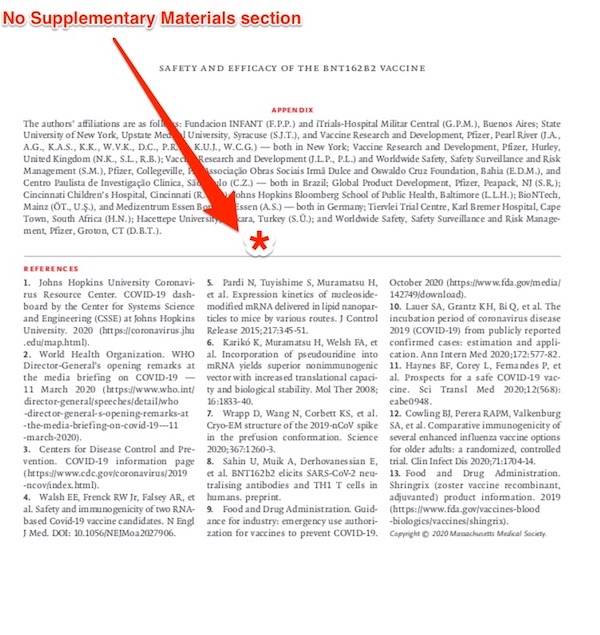
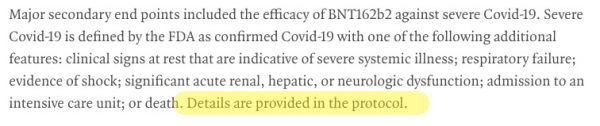
And now we know there were exclusion criteria, not because of anything Pfizer, the investigators, or the NEJM did but because of stunning news out of the UK. UPDATE: I will address this at greater length, but an alert reader did find the study protocol, which were not referenced in any way that any of the nine members in my review group could find, nor were they mentioned in the text of paper or editorial, as one would expect for a medication intended for the public at large. I apologize for the oversight, but this information was not easy to find from the article, not mentioned or linked to from the text of the article, the text of the editorial, in the “Figures/Media,” or in a supplemental document.

In the UK on day 1 of the rollout, two nurses with severe allergies experienced anaphylaxis, a life-threatening reaction to this vaccine. Only after world-wide coverage did Pfizer admit that there was an exclusion criterion for severe allergies in their study.

Ummm, Pfizer, since we are now getting ready to give this to possibly millions of people in the next few weeks – ARE THERE ANY OTHER EXCLUSION CRITERIA? Should I, as a physician, specifically not be giving this to patients with conditions that you have excluded?

Furthermore, NEJM, since you published this trial, have you bothered to at least put a correction on this trial on your website that it should NOT be given to people with severe allergies? I certainly see nothing like this.

Should someone from the NEJM or the FDA be all over Pfizer to ascertain the existence of other exclusion groups so we do not accidentally harm or kill someone over the next two weeks?

Unfortunately, Americans, you have your answer from the FDA about severe allergic reactions right from a press conference in which Dr. Peter Marks, the director of FDA’s Center for Biologics Evaluation and Research is quoted as saying:

Even people who’ve had a severe allergic reaction to food or to something in the environment in the past should be OK to get the shot….1.6% of the population has had a severe allergic reaction to a food or something in the environment. We would really not like to have that many people not be able to receive the vaccine.

Are you serious? Dr. Marks, have you ever seen an anaphylactic reaction? I live in a very rural area. Many patients live 30 minutes or more from the hospital. What if one of them had an anaphylactic reaction to this vaccine hours after administration, had no epi-pen and had to travel a half hour to get to the nearest hospital? There is a very high likelihood that a good outcome would not occur. Sometimes, as a physician, I simply cannot believe what I am hearing out of the mouths of our so-called medical leaders.

To the writers of the editorial accompanying this research:

Did you actually look at the source material? The existence of at least one exclusion criterion for severe allergic reactions had to be in there somewhere. If you did look at the source material, are there others that the physicians of America need to know about? If they were not in the source material, after the events in the UK, has anyone bothered to follow up with Pfizer about this omission?

Does anyone at NEJM or Pfizer or FDA plan to fully inform the physicians of America? Does ANYONE at NEJM or Pfizer or FDA care about patient safety?

Now for the second story that got my attention this week, an article from JAMA Internal Medicine, a subsidiary of JAMA, The Journal of the American Medical Association.

JAMA, like NEJM, is one of America’s landmark medical journals. I will assure you that JAMA is not the National Enquirer. This piece was written by a nursing researcher. It is very likely she is well-versed in all aspects of American medical research.

In her story, she details her recruitment and her experience in the Pfizer COVID trial, the same one we are dissecting here. She describes in detail her experience with the vaccine and the fact that she is concerned that many patients are likely going to feel very sick after the injection. She wrote up her own reactions, and included a very troubling one. About 15 hours after her second injection, she developed a fever of 104.9. She explained that she called her reaction to the Research Nurse promptly the next morning. The recounted the response of the Research Nurse to her information as “A lot of people have reactions after the second injection. Keep monitoring your symptoms and call us if anything changes.”

Thankfully, it appears this nurse has completely recovered. From the best I can tell, this encounter occurred in late August and early September, putting it well within the trial’s recruitment of arms as detailed in the paper.

This JAMA article impinges directly on Figure 2 on page 7 of the paper, a graphic that that lays out all the major side effects during in the trial.

It is very important to note that based on the trial’s own data, conveniently laid out on the very top of the figure in green, blue, orange and red, a temperature of 104.9F or 40.5 C is described as a Grade 4 event. The definition of a Grade 4 event is anything that is life-threatening or disabling. A fever of 104.9 can have grave consequences for any adult and is absolutely a Grade 4 event.

By law, a grade 4 event must immediately be reported to the FDA, and to the Institutional Review Board (the entity charged with overseeing the safety of the subjects) and to the original investigators. THERE IS NO EXCEPTION. One would think that would also be reported in the research paper to at least alert clinicians to be on the lookout.

I could not find any mention of this event in the text of the paper. NOT ONE. Let’s take a closer look at Figure 2 on page 7 where adverse events are reported in a table form. Please note: this is a very busy image, and in the browser version, with very low resolution graphics that are profoundly difficult to read (they are a bit clearer if you download the PDF). This is a time-tested pharmaceutical company tactic to obscure findings that they do not want you to see. My mentor warned me about ruses like these years ago, and finding one raises the possibility that deception is in play.

The area for the reporting of this Grade 4 reaction would be on the 2nd row down at the left of the set called B, titled systemic events and use of medication. The area of concern would be where the graph is marked with the number 16. Do you see a red line there? It would be at the very top. I have blown this up 4 times on my computer and see no red there. I am left to assume that this Grade 4 “Life Threatening or Disabling” event that was clearly within the time parameters of this trial was not reported in this study.

To those who say that I am making way too much out of one patient with a severe fever, let’s do a little math. There are 37,706 participants in the “Main Safety Population” (from Table 1), of which 18.860 received the vaccine.2 Let us assume that this individual was the only one that had a GRADE 4 reaction. Let us also assume that the end goal is to vaccinate every American a total of 330,000,000 people. So if we extrapolate this 1 out of 18,860 into all 330,000,000 of us, it suggest that roughly 17,500 could have this kind of fever. Now assume a 70% vaccination rate, and you get that would be approximately 12,250. I hope you now understand that in clinical medicine related to trials like this – a whole lot of nothing can turn into a whole lot of something quickly when you extrapolate to the entire targeted group. Does anyone not think that the clinicians of America should be prepared for anything like this that may be coming?

A couple more questions for NEJM and the editorial writers:

Were you ever made aware that this Grade 4 reaction occurred? Now that we have a reliable report that it occurred, has there been any attempt to investigate?

Did the Research Nurse actually report this event? If not, was she just simply not trained or was there deliberate efforts to conceal such reactions? How many more reactions were reported anywhere this trial was conducted and that did not make it to the FDA, the IRB or possibly the investigators? Is that not a cause for concern?

As if this is not enough, there is so much more wrong with this editorial. Now we are going to talk about corruption.

I want to reiterate my concern that over the past generation, as my profession has lost its way, its medical journals have turned into cheering sections for Big Pharma rather than referees and safety monitors. We all should relish the great things medical science is doing, but we should be doing EVERYTHING we can to minimize injury and death. Too often our journals have become enablers of Big Pharma deceiving our physicians and the public. Unfortunately, this paper and its editorial look troublingly like a case study of this development.

To provide context, I looked over the last month of the NEJM, the issues from November 12, 19 and 26th and December 3rd. Based on having read the NEJM over the years, I believe these four weeks are representative.

During this period, there were 15 original articles published in the fields of Oncology, General Surgery, Infectious Disease, Endocrinology, Renal, Cardiology, Pulmonary and Ear Nose & Throat. Of these 15 articles, the editors thought that eight were important enough to have an editorial from an acknowledged expert. I have read every one of these studies and the editorials as I do every week. All eight in the past month were indeed by leading experts in the field of the underlying studies. They included a COVID vaccine overview reviewed by an leading figure in vaccinology, and two COVID papers about Plaquenil and other approaches discussed by top infectious disease experts.

It was unlikely that those papers were going to get national media attention. All medical stuff.

But here we have our Pfizer vaccine paper. We have 300,000 fatalities in the USA alone and millions of cases. We have whacked our economy, we are in the depths of a national emergency. And we have a paper, the first, that may offer a glimpse of hope. Certainly this would be a landmark paper, and certainly it was treated in that manner? Right?

One would think that the doctors of America would have this study explained to them by a world-known vaccinologist? NOPE…..Maybe a virologist? NOPE….. Maybe a leading government official? Dr. Fauci? Dr. Birx? Dr. Osterholm? NOPE…..Maybe an expert in coronaviruses? NOPE…

We get the Pfizer ad glossy editorial treatment from Eric Rubin MD, the editor-in-chief of the NEJM. And Dr, Longo, an associate editor. Dr. Longo is an oncologist. Dr. Rubin is at least a recognized infectious disease doctor, but his specialty based on my Google search is mycobacterium, not virology. Again, one would normally anticipate for a paper of this importance, the editorial would be from someone with directly on point expertise.

Why would this fact been important to my mentor? (and I had the privilege of hearing him trash a paper in an open forum about a very similar issue, a paper introducing a drug to the world that later was the disaster of the decade, Vioxx) Why is this important to me and all the other physicians in my review group here in flyover country yesterday?

Because the choice of authorship of the editorial leads you to one of only several conclusions:

• Pfizer would not release the source data because of proprietary corporate concerns and no self-respecting expert would review without it
• Pfizer knew there are problems and did not want anyone with expertise to find out and publicize them
• The editors could not find a real expert willing to put their name on a discussion
• Drs. Rubin and Longo are on some kind of journey to Vanity Fair and wanted their names on an “article for the ages”
• This is a rush job, and no one had time to do anything properly, and so we just threw it all together in a flash

Readers, pick your poison. If anyone can think of a sound reason, please let me know. I am all ears.

But let’s open up the can of worms a bit more. Pfizer supports NEJM. Just a brief swipe through of recent editions yielded several Pfizer ads. A Pfizer ad appeared on my NEJM website this AM. I do not know how much they pay in advertising but appears to be quite a bit.

Americans, have we devolved so far in our grift that it is now appropriate for the EDITOR-IN-CHIEF of our landmark medical journal to be personally authoring “rah rah” editorials about a product of a client that supports his journal with ad dollars? And he has the gall to not present this conflict on his disclosure form? Really? Am I the only one worried about this type of thing?

Now we travel from the can of worms to the sewer. And this impacts every single one of us. I want you to Google the names of the people on the FDA committee that voted 17-4-1 two days ago to proceed with the Emergency Use Declaration. Go ahead – Google it. On that list, you will find the name Eric Rubin, MD. Why yes indeed, that is the very same Eric Rubin MD who wrote this editorial. Who is the Editor-in-Chief of the NEJM. A publication that certainly takes ad dollars from Pfizer. And he was one of the 17 to vote for the Pfizer product to be immediately used in an emergency fashion. Oh yes, oh yes he was.

Am I the only one who can recognize that Pfizer and other pharma companies may have some influence on Dr. Rubin thanks continued support of his employer, the NEJM? Am I the only one concerned that Dr. Rubin’s “rah rah” editorial may have been influenced by Pfizer? Is anyone else troubled that the Editor-in-Chief of the NEJM, supported by Big Pharma advertising dollars, is sitting on an FDA board to decide the fate of any pharmaceutical product? Is this not the very definition of corruption? Or at least a severe conflict of interest? I strongly suspect that a thorough evaluation of members of that committee will reveal other problems. As my grandmother always used to say, “There is never just one roach under a refrigerator.”

I looked in vain all day today for media discussions of conflicts of interest with Dr. Rubin or anyone else in a position of authority. I found nothing.

What I did find was the Boston NPR affiliate WBUR discussing Dr. Rubin’s Yes vote. You can listen yourself:

This interview left me much more concerned about Dr. Rubin’s role and what exactly he read in the raw data from Pfizer. In this interview, he admits that he as an FDA advisory member has seen no data from the Moderna trial coming up for a vote this week:

These two vaccines are fairly similar to one another, so I am hoping the data will look good, but we haven’t seen the data yet, so I reserve judgement.

Excuse me, but should not the members already have the data and be mulling over it to ask intelligent questions?

These statements left me more worried about the issues I have already brought up with the Pfizer vaccine:

We don’t know if there are particular groups that should or should not get the vaccine…We do not know what will happen to safety over the longer term.

When finally asked specifically about the UK allergic reactions and if they came up in the FDA meeting (emphasis mine):

It did come up and this was a bit of a surprise because in the trial, that trial was limited to specific kinds of participants, there were apparently no incidents like that, nevertheless this suggests it is something we are going to have to look out for.

There is absolutely not a word in the published data to suggest there was a limit to SPECIFIC PARTICIPANTS – what on earth is he talking about? Are there limited specific kinds of patients that we as physicians should be looking to vaccinate?

In a fine finish, toward the end of the interview Dr. Rubin states he is a bit relieved that low risk patients will be getting the vaccine later after we know more about the side effects with the first patients. I am really not trying to be a jerk – but are you kidding me? I thought this vaccine was a triumph with minimal side effects.

Dr. Rubin, kind sir, I really feel that you owe a clarification about your statements in the WBUR interview to the patients and caregivers of America. We are the ones with lives on the line.

First, I have the privilege of sitting on an Institutional Review Board (an independent entity that protects patient safety) and I know something about Grade 4 side effects. Just for 1 Grade 4 side effect in one subject, the accompanying documentation would often be a half a ream of paper. Because I agreed to do that job, it was my obligation to look through that documentation. That half a ream was for one side effect in one trial. Yet, you state unequivocally in this interview, that you, as a sitting member of the FDA committee that oversees the safety of the nation in this affair, have not seen any of the Moderna documentation for that upcoming meeting this week.

For readers to fully understand what I am saying, this Moderna documentation is going to be reams and reams of documents that need to be evaluated carefully to ask the right questions. And you have not yet studied this? For a meeting in just a few days? I find this deeply troubling. Your statements create the appearance the committee you are sitting on is nothing more than a rubber stamp for a decision that has already been made. This would be an absolute tragedy.

Second, Dr. Rubin, you in your position as the Editor-in-Chief of the NEJM and the editorial writer for this research, may be one of the few people on earth that have seen the original Pfizer research. Despite calling this a triumph, you state in the interview that you are relieved that younger people less likely to get the vaccine early so you will have time to wait to see if complications develop in the first patients. You have stated, despite your assertion in the editorial that the side effects were consistent with other vaccines, that “we don’t know if there are particular groups that should or should not get the vaccine”. Have you seen something in that “triumph” research that is concerning enough to you to make such statements? As a physician, I would really like a clarification on this statement, given that the shots are already rolling out today.

Now that we are past the editorial, a few words about the nuts and bolts of the paper.

I look for very specific red flags – usually making the data difficult to interpret. This study did not disappoint.

On page 5, in Table 1, the Demographic Description of the participants, go down to the AGE GROUP area. Note it is divided into only two cohorts 16-55 and >55. This is a real problem. My mentor said an honest paper should never deploy such a tactic.

You see, more than half of my patients are over 70. Why is this kind of obfuscation a real problem for my ability to trust the vaccine? Well, the intro papers to many pharmaceuticals that have gone down the drain in recent years have used this very same device. It is their way of hiding the fact that they did not put many older patients in the trial, certainly not representative of the population, and certainly not representative of who is seemingly going to get this vaccine in the first round. Do I know that 90% of the >55 group is actually between 55-58? I don’t. How hard would it be for them to do a breakdown in decades? 16-25 26-35 36-45 46-55 56-65 66-75 76-85? We have lots of computers in this country and the population breakdown is done this way on studies I read all the time. Why not do provide this information on a study that is this critically important, particularly one where elderly patients will be near the head of the line?

What are they trying to do here? Unfortunately, too often drugmakers resort to this practice to hide their failure to test their drug on the elderly to an appropriate or safe degree, knowing there would likely be lots of problems. Because of their past behavior, I ALWAYS assume this is true until proven otherwise and act accordingly with my elderly patients.

That is the world these companies have made for themselves.

Now for the tables on pages 6 and 7 about immediate side effects.

Just a brief look shows that local soreness and tenderness is very common, up to 75% with this vaccine. That is a bit high, but not that far out of range from my experience with other vaccines.

The tables on page 7 are the whoppers.

Headaches, fatigue, chills, muscle pain and joint pain appear to be very common, way more common than other vaccines I am used to, as in an order of magnitude higher. It is very clear from this table that about half the patients, especially the younger ones, are going to feel bad after this vaccine. That is extraordinary.

We are told nothing about how long these symptoms last or the amount of time at work lost. The “minimal side effects comparable with other viral vaccines” in the editorial and press releases is just not consistent at all with my experience of 30 years as a primary care physician. There was universal agreement with this assessment among my MD colleagues. They had great concern about this as a matter of fact: great concern that it will cause bad publicity and decrease administration and great concern that given this already high side effect profile, it may be much worse when it gets out to the public.

Given the fact that this virus is largely asymptomatic in more than half the people infected, what exactly are we doing here?

Furthermore, unlike other pharmaceutical papers that try to explain variances in symptoms like this, there is not a word offered about possible underlying causes of these outcomes.

The numbers of COVID cases in the placebo group vs the vaccine group have been widely publicized, from 162 cases in the placebo group down to 8 in the vaccine group, giving a relative reduction of 95%. It seemed to all of us in our review group that we do not have nearly enough patients to really make assessments. That is not a criticism. The researchers have done admirably in my opinion to get this many patients this quickly. That is still the problem: they are going to be using the first million patients or so in the general public to get a real gauge on numbers and side effects.

Another issue of grave concern to us all on Friday was the asymptomatic cases. The only subjects counted in the 162 and the 8 numbers above were patients with symptoms. Who knows how many in each cohort were asymptomatic.

This to me leads to the most important question of all, and it was again completely untouched….. How many asymptomatic patients are there? And how many who were vaccinated are still able to spread the virus? Not even an attempt to answer that question. This is critical, and is one of the ways a vaccine can backfire. If a vaccine does not provide sterilizing immunity, ie stop transmission, it is of limited use for disease control. It is great for the individual, but if they can remain without symptoms and still spread it all around it does not help from a public health standpoint.

I have described my concerns and red flags about this study. I would like to add one more thing. Pharmaceuticals that go bad rarely do so in the first few weeks or months. Rather, the adverse effects take months or years. It is a known unknown of not just vaccines but any kind of drug. Our pharma companies have become notorious for having inklings or indeed full knowledge that there is a problem early on, and saying nothing until many are maimed or killed. I will assume that this is the case in this class of drugs until proven otherwise. They are such deceivers I have no choice.

Due to sense of urgency my colleagues and Ifeel about this vaccine rollout, we had an ad hoc meeting of our Journal Club to discuss the NEJM article. Of the nine physicians at the meeting, three have already had very mild cases of COVID. Of the nine, only one is enthusiastic about these vaccines. I have a wait and see stance. I will not be taking it myself. I have too many scars, too many staring at me from the grave to take any other approach.

My patients’ feeeback on the COVID vaccine has been very different than the polls finding that 60% are ready to take it. About half my patients are in the professional/managerial classes and feature a higher level of the 0.1% than the US overall. They tend to be more blue. Most prefer to wait and thankful that health care workers were getting it first. The other half who are working class, more red, and they feel the whole thing is a hoax. They will not be getting the vaccine – likely ever.

The only enthusiasts I would call elderly Rachel Maddow fans. That really makes no sense to me at all since Operation Warp Speed was a Trump project and even Kamala Harris said she would not take a vaccine that Trump recommended.

I would say AT BEST 25% of my patients will be getting this vaccine shortly after being available. There is widespread skepticism that is not being acknowledged by our media. The pharmaceutical industry has worked tirelessly to earn every bit of that disrespect.

Please look at Dr. Angell’s seminal article from 2009. She predicted in her works, all of this and more. My profession has been captured by a cabal of corporatist MBA clones, rapacious and unethical pharmaceutical entities, and an academic elite addicted to credentialism and cronyism. They have over the years bought off and infiltrated all of our government health care regulating agencies and our public health system. And they are completely incestuous. I believe where we are now to be worse than Dr. Angell could have ever dreamed. Even more depressing, I see no way out.

____

1 As a special homage to the polio patient described above, a truly exceptional woman, let me underscore that the disastrous rollout of the this polio vaccine came at a time similar to ours. Panic and malaise were in the air. The children of America and the world were being stricken with polio at an alarming rate. Dr. Alton Ochsner, a leading figure in medicine of the day, vaccinated both of his grandchildren in public in an attempt to bolster confidence in the vaccines. Within 8 days his grandson was dead of bulbar polio. All the celebrities and politicians lining up to take this vaccine on national TV should remember this tragedy. “Stupid human tricks” like this have no place in this kind of situation, and can backfire in unexpected ways. Unlike that era’s polio vaccine, there is no way on earth this vaccine can transmit COVID. However, there are those of us in the medical profession who treat the plan to make population-wide use of messenger RNA, which before these trials had been repeatedly investigated but never reached the human trial stage save in a small scale Zika vaccine study. This is no time for machismo. This is also no time for anything less than complete transparency on the part of everyone involved in the quest for safe and effective vaccines. To behave in any other way is an affront to patients like mine who have suffered and died in the past.

2 If you read the paper, you might well have wondered about that 18,860 number and even checked Table 1 to make sure it’s accurate (it is), since the third paragraph of the Abstract, under the headline “Results,” has very different figures:

A total of 43,548 participants underwent randomization, of whom 43,448 received injections: 21,720 with BNT162b2 and 21,728 with placebo.

So how did the researchers get from 21,720 injected with the vaccine to the 18,860 in the “Main Safety Population”? This sort of thing confirms the impression that this is a very incomplete or sloppy study. It is really not clear where the difference between the 37,706 and the 43,548, or for that matter, the 36,520 total subjects in the Tables 2 and 3 (Efficacy) come from. I used the 37,706 and hence the 18,860 that went with it from Table because it gave slightly smaller numbers than using the Table 2 and 3 figures, but they would be close to each other.

My concern here is the 6000ish discrepancy between the figures in the main text compared to the tables. Were they excluded? If so, why? I could not make heads or tails out of this, and accordingly kept it out of the body of this post. This kind of inconsistency really needs to be hashed out with the actual source data in hand, and should have been explained in the article, even if just in footnotes.

IM Doc's later comment (that prompted the post's update):
IM Doc

Yves has just informed me that there is a list of exclusion criteria. That is an oversight on my part. When I have a moment today – I am going to look through this. I am rather busy right now with patients.

Right up front, this is to make my point exactly. I have never been this busy in my life. I am seeing sick patients like never before in my life. My colleagues all across America are as well. All of the nine docs that I discussed this with had no idea of the presence of this document – likely because we do our sessions from paper hard copies. These pages and pages of documents are simply not readily accessible to any of us nor do we have the time to sift through it all. This is my point – These types of issues should be in the research paper or editorial itself. It should not be an Easter Egg Hunt. I would think it appropriate that NEJM the minute there was an issue about exclusion criteria in the UK should place a black box on the front for all to see – “Please look at pages XX-YY regarding exclusion criteria in this study – This is a patient safety issue.” If this was noticably placed on the front page of the trials website – there would not be an issue.

To the readers here – I am sorry for this oversight – I will look through this the minute I have a moment.
 

grayslady

Fun facts on who was excluded from Phase I trials by Pfizer:

Individuals with high blood pressure (estimated by HHS to be 30% of U.S. population)
Individuals with asthma, COPD and/or using corticosteroids for breathing issues (according to ODPHP, 25 million Americans have asthma and almost 15 million American adults have COPD)
Individuals with a BMI greater than 30 (according to WHO, over 36% of all Americans are obese)

Aren’t these supposed to be some of the people who need Covid protection the most?
 

IM Doc

I am not sure my comment is exactly in line with your comment and question –
But here it goes –
This list is in referral to PHASE I – or STAGE I trials –
These types of lists are very very common – as STAGE I or PHASE I trials – are where the investigator is trying to find out the doses that are safe – and what the immediate side effects of all kinds of dosing range – the same basically goes for STAGE II. This type of exclusion does not concern me at all –
This type of experimenting can be hard on the human body – and it is always better to have 30 year old healthy jocks – not 70 year old COPD diabetics. This is perfectly within line.
PHASE III trials like this pfizer one – are and should be open to much more patients to give a full spectrum – these are going to have trials with real drugs (the dosing and SE distilled from the PHASE I and II trials) and placebo arms.
You can rest assured that many obese and diabetic patients were in this study – by looking at the results and safety tables- their numbers are right there.

IM Doc pt3

Aug. 11th, 2021 09:09 pm
temporaryreality: (Default)
Working in date-posted order, here's the next set of comments by IM Doc. Please see the updated link in the topmost IM-Doc related post on this blog to find the current discussion location.

antidlc

https://www.nytimes.com/2020/12/16/health/covid-pfizer-vaccine-allergic-reaction.html
Alaska Health Worker Had a Serious Allergic Reaction After Pfizer’s Vaccine

The person did not have a history of drug allergies. Two similar reactions happened last week in Britain.

A health worker in Alaska had a serious allergic reaction after getting Pfizer’s coronavirus vaccine on Tuesday and was hospitalized, according to three people familiar with official reports of the person’s health. The person was still in the hospital on Wednesday morning, under observation.

Government officials were scrambling on Wednesday to learn more about the case. The worker had no history of drug allergies but it was unclear whether he or she suffered from other types of allergies, according to one person familiar with the case.

With millions of Americans expected to be vaccinated by the end of the year, the incident is likely to prompt federal officials to be even more watchful for any sign of serious side effects. The Alaska recipient’s reaction was believed to be similar to the anaphylactic reactions two health workers in Britain experienced after receiving the Pfizer-BioNTech vaccine last week. Both of them recovered.


I was in a Grand Rounds webcast this AM –

There is a theory this is happening because of the PEG (polyethylene glycol) fat envelope. I repeat – a theory. PEG is a very common thing in many products – make-up, cosmetics, toothpaste. And there are random patients out there who have pretty severe allergic reactions to it when they put it on their face in the form of makeup. Now imagine a bolus in your veins – and you can see the possible problem.

There are of course countless other issues that could be going on. Have immunologists studied this? I do not know. From the very best I can tell online, the lipid coats are proprietary. Are Pfizer and Moderna going to do a Jonas Salk impression and let the world know their exact make-up for the case of patient safety? Have they already done so and I just cannot find this fact online? I do not know.
 

Amfortas the hippie

when me and mine say “allergies” it means allergic to stuff in the air, from mold spores after a rain to that damned “cedar fever” we all get out here from october to march.
my youngest had them really bad when he was tiny…enough to where we’d pull him out of kinder and drive 50 miles to the nearest hospital once a week to get an allergy shot.
so i had a 5 year old boy, rolling on the floor of the infusion lab, entertaining the chemo patients.
they’d make us wait for 30-40 minutes before leaving…and we carried an epi pen, before medicaid stopped paying for them.
is this sort of “allergy” included when they say people with allergies should be careful, or are in the exclusion group?

 
  1. IM Doc

    This is a very nebulous point at this time.

    The exclusion criteria from the Pfizer trial in the literature was limited to allergies to vaccines and vaccine related chemicals – and any known allergy to a constituent of the actual vaccine in the study. How people were to know that is unclear.

    Once the 2 UK issues occurred, it was broadened out to “severe” allergies in general – if not by pfizer itself by multiple experts – those links have been posted in the past few days. It is still not really clear from Pfizer – at least that I can tell.

IM Doc

I felt like I should make a little comment here about the new info coming from the Moderna trial and yet another issue that I think is being irresponsibly handled by our media.

As I was in the Doctor’s Lounge – I heard the following on TV – “What do you say about these vaccines causing Bell’s Palsy?” This is totally irresponsible.

I have heard this described in the past 24 hours as a trend. Again totally, irresponsible.

I have also heard minimization of this from the pro-vaccine crowd. Basically stating nothing more than the usual background noise. I do not believe this is actually the case. I need to really look into the incidence of Bells’ palsy, but this incidence of 7 patients out of the size of these cohorts seems a bit excessive to me just on the face . At this point we have disparate data points in 2 studies who do not really have enough subjects to make any conclusions at this point. No one should refer to this as a trend, yet. And there is certainly no evidence yet of causation. Small cohort sizes make it very difficult to ascertain safety issues like this, important conclusions cannot be made from these small cohorts, and this issue and likely others will now be evaluated on the American Public.

I have not formally read the Moderna study, but it seems to me from overviews that we are determining success by the same metric as the Pfizer study – which is case numbers. Basically flu-like illness. Again, far too rapid studies to determine mortality or morbidity, unfortunately, and case numbers are a fuzzy mirror. I see nothing in the study following other symptoms or manifestations of this disease after the initial illness of flu-like symptoms. I cannot stress too much, in my world, this post-COVID syndrome is becoming a much bigger problem daily. Much much more common than death. I am seeing many Post-COVID patients with a severe fatigue problem, neuro or cardiac issues, or profound depression. And blood clotting issues. I knew about this type of thing in July – these studies were enrolling after that. It would be nice if they would allow their data sets to be opened to see if their vaccines had any effect on these symptoms, or if there was any incidence/prevention of them in the cohorts after the first blush of symptoms. That would be confidence building.

IM Doc

A point of correction, the way I see it.

The Phase III trials at least the ones already completed in the past few weeks and reported and voted on by the FDA – are OVER.

You could never ever be giving meds or vaccines or anything to the general public in a PHASE III trial. They require an IRB oversight and an investigator.

This is also not a PHASE IV trial – that is a post marketing study – and the patients still need to be enrolled in a trial. I have no idea how you do a PHASE IV trial in the setting of an emergency use authorization. I do not believe it can be done. I would defer to research gurus that really know how to set up studies.

This is implementation to the public on an emergency use authorization. This has not received formal approval from the FDA in the standard sense. You are correct that side effects and problems are now going to be followed on the public at large. This EUA is unique in that it encompasses all of us. Before this year, I had always pictured these being used to speed things up for critical cancer drugs, etc.

TroyIA

I’m not a doctor but thought I would share this link about Bell’s Palsy.

The most potent risk factor in the development of Bell’s palsy is diabetes mellitus. Other risk factors include lyme disease, arterial hypertension, autoimmune inflammatory disorders, viral infections and lipid disturbances.

For the doctors, since the MRNA vaccines are wrapped in lipid nanoparticles could this create enough of a disturbance in select individuals, especially those with other risk factors, that Bell’s Palsy develops?

 
  1. IM Doc

    This is really very unlikely going to happen.
    No matter if it was pure lard, there is simply not enough fat in an injection to make any difference in the Lipid Panel. Furthermore, the lipid disturbances they are referencing are very remote, very rare lipid problems. I see about 1 Bells Palsy patient every other year or so. It has in my life been diabetics that are out of control that are the primary victims. I honestly do not recall anyone with an inflammatory Bells Palsy. – It is in the textbooks, just not common enough that I would have seen it in 30 years of practice.

    I would also caution you to be very careful about assuming that the vaccine caused the Bells Palsy in these test subjects. That has not been shown to be causative yet at all. There are simply not enough patients in the cohorts.

  1. JBird4049

    Is it possible that some of the post COVID issues is “just” sheer exhaustion and wear on the body? Even though it has been in the States since before March that is still less than a year. Could the actual length for a complete recovery just be very long?

    I ask because I had “only” pneumonia when I was thirty. Three-four weeks of trying to breathe and mostly not eating or sleeping followed by at least two months of slowly getting my energy, stamina, and mental clarity back after I had “recovered.”

    Honestly, I was too exhausted during the illness to even have the mental energy to worry about survival. I don’t think it did anything permanent damage. It just used up all of my body’s resources, which I then had to spend months getting back admittedly while working full time in retail. Fun times.

     
    1. IM Doc

      I am beginning to think that the virus is able to cause diffuse widespread damage at a micro level in a lot of people.

      I do not think they are worn out in any traditional sense. I think people have been literally damaged. I have one too many 30 year old jock types who cannot get out of bed. They would normally have recovered from regular types of infection in no time.

      This is very troublesome to me. It is way more common out there than death or hospitalizations.

IM Doc pt4

Aug. 11th, 2021 09:13 pm
temporaryreality: (Default)
Please see the updated link in the topmost IM-Doc related post on this blog to find the current discussion location.

Further Discussion of the Red Flags in the Pfizer Vaccine Paper in the New England Journal of Medicine

Earlier this week, we posted An Internal Medicine Doctor and His Peers Read the Pfizer Vaccine Study and See Red Flags [Updated]. Most readers responded very positively to the write-up by IM Doc, which included the reactions of the eight other members of his Journal Club who reviewed the article and its editorial, as they have done regularly with important medical journal articles. We have embedded the Pfizer article from the New England Journal of Medicine (NEJM) below; the link to the editorial is here.

However, some took issue with IM Doc noting that two nurses in the UK had suffered anaphylaxis, a severe, potentially life threatening allergic reaction, after getting the Pfizer shot. IM Doc criticized the paper and editorial for not including or adding a discussion of any exclusion criteria, particularly since Pfizer’s proxies admitted that severe allergies were an exclusion criterion. From MedicalXpress:

Moncef Slaoui, who is the chief advisor to the US program for COVID vaccine and treatment development, told reporters, “Looking into the data, patients or subjects with severe allergic reaction history have been excluded from the clinical trial.

“I assume—because the FDA will make those decisions—that tomorrow this will be part of the consideration, and as in the UK, the expectation would be that subjects with known severe reactions, (will be asked) to not take the vaccine, until we understand exactly what happened here.”

Slaoui is the co-head of Operation Warp Speed and previously head of GlaxoSmithKline’s vaccine department. Other media outlets and professional medical writers (see here and here for examples) picked up his statement that subjects with severe allergic reactions were excluded.

If you look at the article below, you will see that it is not searchable. That indicates an expectation that it would be read as a print out only. You will find it make no mention of “exclusion criteria”. Neither does the the separate editorial by NEJM editors. The article does does mention “protocols” in the text, twice, but does not have a link to where to find them, does not have a written URL, nor does it provide a name or location to assist in finding them.

Some critics argued that the protocol (which you need to search through to find the selection process for candidates, including the exclusion criteria, for the Phase III trials) could “easily” be found in the Supplemental Materials and further asserted that any regular reader of medical papers would be able to find then. The fact that IM Doc, who has been reading medical papers for 30 years, and his eight colleagues did not locate them is already significant counter-evidence, particularly since the NEJM’s media kit lists the publication’s audience solely as physicians. No doubt scientists read it too, but the eyeballs advertisers really want to reach are doctors, academics or scientists in the employ of competitors.

IM Doc could not find the Supplemental Materials because the PDF that the NEJM generates does not include them. It is in the online version, and opens up to a dropdown menu, with the first item “Protocols” which takes you to a document via an external link. Since readers have every right to assume that online and PDF versions of the same article are identical, there was no reason for him to look further.

It turns out that the data waters appear to have been muddied by the NEJM itself. IM Doc and his colleagues found and read the Pfizer paper late last week. It was then on the first page of the site. He sent me his write-up on Saturday the 12th. I went to look at the article and charts on the NEJM site. It was then on the front page of the site. I experienced rendering issues in Firefox but nevertheless was able to look at the article, along with the separate tab in the header area for “Figures/Media”. I also noticed a “Supplemental Appendix,” which I opened. It was a bit of a hodge podge but didn’t contain anything that related to IM Doc’s observations. I did not see any tab with “Supplemental Materials.”

IM Doc did a big revision of his draft on Sunday, which I edited that evening. IM Doc was a bit freaked out Monday AM when the Pfizer article has moved off the NEJM front page, but he quickly located it on the site. I looked quickly, simply registering that I could find it and see the charts, but I did see that the rendering problems were no longer occurring.

I was not the only person who recalls seeing the “Supplemental Appendix” (notice NOT “Supplemental Materials”) as a stand-alone document with a link to it in the top area of the NEJM site before December 12 (sadly, the Wayback Machine allows publishers to suppress older versions of articles upon request, so there is no image of the article as it initially appeared on the first page of the NEJM site).

Fortunately, reader KLG harrumphed about the Supplemental Appendix in comments. KLG is a professor of microbiology and has been doing basic research for 30 years, so he can’t be dismissed as inexperienced in reading scientific papers. I asked for his recollection of what he found when he went to the Pfizer article:

Here is how I remember finding the paper, after seeing the post from IM Doc yesterday. I apologize if this is TMI, but I want to be as clear as possible:

(1) I clicked on the link while in my office and gained direct access through our medical library, downloaded the pdf, and printed it on a high-resolution color printer, which is my standard, old-fashioned practice. I then read through the paper fairly quickly, and thought it was OK/promising but not necessarily complete.

(2) I saw no obvious (printed) link in the pdf to any supplementary materials, so I went back to the online link to the paper through our library (full access to most medical journals). I saw the link to the 12-page “Supplementary Appendix” with the 4 pages of names and downloaded and printed it. This link was on the right side of the screen/page, near the top. This link was not at the bottom of the single page of the paper as I see NEJM.org from home this evening, along with the other links, including Protocols, Disclosure Forms, etc. I am not accessing the journal remotely through our library tonight and would be seeing it as “outsiders” do. The point for me is this: One link to supplementary material should go directly to all supplementary materials. This has been what I have been accustomed to for years. Sometimes the files are ridiculously large and there may be 10-15 of them, but they are all there and easy to find. If one link cannot be managed, then all links should be in the same place on the webpage, listed one after another as S1, S2, S3, etc.

(3) Still, I may well have missed these other links, because while I am very skeptical of “science” direct from Big Pharma, my forensic antenna were not fully deployed until the usual suspects showed up later in the day as I checked back in to see how things were going.

(4) But more importantly, I do not believe for a second that IM Doc and his like-minded journal club (a common mechanism for all biomedical scientists and many clinicians to keep up with current developments) would have missed these materials, if the links were properly displayed as they should have been on day-one. As I mentioned in my previous email, so-called supplementary material has become a thing, for good or ill, in biomedical publishing, and in my experience the links are prominent in strong journals (and NEJM is definitely that, or certainly was when Marcia Angell was editor). Moreover, IM Doc undoubtedly has a subscription to NEJM, which should have displayed the links prominently both in hard copy and online. Based on his every contribution to NC, IM Doc seems uncommonly attuned to both the practice and science of medicine, going back to the beginnings of the HIV/AIDS epidemic, which made a deep impression on all of us who were there, clinicians and non-clinicians alike. That is when we learned to parse the literature and separate the wheat from the chaff. And there was a lot of chaff in the HIV/AIDS literature from ~1983 until triple-therapy was published in 1994 IIRC and AIDS became a chronic, manageable condition for most of those infected with HIV.

Let us stress again, as you can see from the PDF below, which I downloaded Monday morning: In the PDF, there are no Supplemental Materials nor any reference to them. The Section is completely omitted. This is where the link to the Protocol would be found, were NEJM to have followed its usual practice in other articles.

In other words, NEJM initially either did not present the Supplemental Materials tab at all or through terrible design, directed reader attention away from it by having a prominent Supplemental Appendix link at the top, which experienced readers would assume contained all of any additional documents, save any others mentioned and/or linked to in the article proper and/or the editorial. And even when it cleaned that up, NEJM did not update the article to include a link or printed URL, or a reference.

In addition, even after readers in comments had pointed out where to find the exclusion criteria (in the Supplementary Materials, in Protocols, meaning two clicks and a search, when it should have been easier to find), other had difficulty finding it and also deemed the material to be poorly presented:

SE

Thank you for highlighting the exclusion criteria. When I looked at the NEJM article, I was also unable to find them. I noticed that a reader has since posted them, and you updated the post. I also found the on Pfizer’s website. https://www.pfizer.com/science/find-a-trial/nct04368728-0

California Dreaming

My wife is a graduate of Stanford Medical School and is a subspecialist in Internal Medicine. Not infectious disease. She was at the top of her class. She graduated a bit more than 10 years ago. I was so intrigued by this doctor’s post that I wanted to do a little test, admittedly with just one subject. As you can see I was an early commenter and have skin in the game because I live with a doctor.

I wanted to see if she could identify quickly the exclusion criteria just like this doc has now admitted was confusing but actually there. She could not do so quickly – and it took her about 45 minutes to do so and then she stated to me when looking through them how recklesly they were spelled out. She was surprised. Phase 1 stuff all mixed in with the others. She was also very concerned about the fact that there were so many common conditions that had not been studied or included in a wide population impact drug like a vaccine. Concerned about why these are not being more publicized given the fact that we will be trying to vaccinate presumably everyone. Should this not be publicized more with both docs and patients.

This discussion should put the question of the adequacy (not) of the NEJM presentation of information about the Pfizer vaccine to rest. It was incumbent on the New England Journal of Medicine to provide a concise overview and ready access to details important to practitioners to help them assess a medication intended for the entire population, yet developed and approved on a corner-cutting basis. They fell short.

Lambert, who in a prior life was a document analyst and developed schema for medical journals, was taken aback by other data presentation failings in these pieces. He intends to discuss them in the near future.

[to see what was inserted here, please go to the original post, linked via the orange title]

Eustachedesaintpierre

My Mother is actually being Pfizer vaccinated today, but according to my sister who is her carer the old girl is already slipping away due to her physical state & the Alzheimer’s. Sis isn’t getting much sleep as she has to increasingly give Mum a nudge when she hears her breathing stop. I guess it is only a question of short time now, of which the vacc will likely make no difference or perhaps tip her over the edge. I just hope that it doesn’t cause discomfort & to be honest I hope Sis misses a breathing lapse fairly soon for her own sake & Mum’s as the latter’s quality of life is very poor – easy for me to say of course as I won’t be the one to find her gone.

I would have stopped the vaccination but it’s not my call.

IM Doc

Ma’am or Sir,

FWIW – I don’t know your mom or your family.
But your situation is the exact reason why immunizations should be handled by a PCP who knows her and her story well. To degenerate them into every one line up in the parking lot and get them one by one is not the best idea. We are in a crisis and we may well have to do things not the best. I keep telling myself that.

I have been a provider in this pandemic from Day 1. I have seen nursing home and rehab patients many of whom have dementia enough to make them unable to understand their circumstances. All across the land they have been turned into literal prisoners. It has not been a good scene.

I would suggest to you that you step back and evaluate the risk and benefit to your mom in her current situation as I am with every single patient. She sounds like she has a limited life span – and a limited quality of life. If this vaccine allows her to not spend that time as a prisoner – I think that sounds like a win for everyone involved. If she has a vaccine complication that is life ending (profoundly unlikely) – in my opionion that would have been worth the risk. One thing is for sure – you should not stress once you make the decision.

Good luck and God be with you.

re: “The wealthy scramble for COVID-19 vaccines: ‘If I donate $25,000 … would that help me?'” [Los Angeles Times]. “They’re offering tens of thousands of dollars in cash, making their personal assistants pester doctors every day, and asking whether a five-figure donation to a hospital would help them jump the line. The COVID-19 vaccine is here — and so are the wealthy people who want it first. ‘We get hundreds of calls every single day,’ said Dr. Ehsan Ali, who runs Beverly Hills Concierge Doctor. His clients, who include Ariana Grande and Justin Bieber, pay between $2,000 and $10,000 a year for personalized care. ‘This is the first time where I have not been able to get something for my patients.'” • That last sentence is even more frightening than the headline, since it implies that the entire health care system is rotten from top to bottom; everything is for sale.
 

Milton

His clients, who include Ariana Grande and Justin Bieber, pay between $2,000 and $10,000 a year for personalized care.
Holy crap! So concierge service is less expensive than ACA Bronze options? I think a zero, or two, is missing from those dollar amounts.

IM Doc

No, that is about right.

That covers only the services of the PCP. It is not lab, x-rays, surgery or anything else.

Anything else – hospital, rehab center, specialists, ER – is untouched by the concierge service – it is all on the patient.

It is the most absurd model ever. The specialists HATE it because the PCP concierge docs call them and demand special care because of their own payment model. The PCPs are under extreme demand to produce rapid service. This can be very irritating to the specialists who are not in on the deal.

The patient is in effect paying the PCP fee to have expedited consults and referral visits. At the expense of everyone else.

When the PCP converts to this model, their patient cohort goes from 1800 or so down to 300. The other 1500 get sent to the winds and picked up by other PCPs who are already overburdened.

I have known many colleagues who have regretted changing to this model very quickly. Rich people are often very boring on top of malignant personalities. Your 300 patients have your cell phone – and begin to call and ask if it is OK to put avocados in their soup. Yes – that is a true story.

It is all so tragic. And all so America.
 

IM Doc

A bit of clarification medically.

Anaphylaxis is a different breed than a normal allergic reaction. It may not be fully in force for hours after the allergic exposure. Sometimes, it is instant but most of the time it is not. Furthermore, it often takes days or hours to mitigate. Epinephrine usually makes it better, but until the allergic issue itself is resolved, once the epi wears off the symptoms will re-emerge.

It is important to note, epi-pens are never meant to be a one time “shot” to cure anaphylaxis. They are meant to stabilize the patient until they can get to a hospital. The patient often ends up admitted for a day or two until the allergic reaction is gone.

Having people wait around the Kroger is just not going to solve this issue. The arrival of the symptoms may be gradual and it may be hours. It is very concerning to me in a rural area because so many patients are so far away from care and this could happen many hours after the injection.

To be a bit morbid, this is a horrendous way to die. The patient is turning all different colors, they are fully awake and in absolute terror, and the only sounds they can make are that of a barking seal. In medicine, this very often initiates in the hospital setting and is instantly taken care of. We do not get to see this in full force. As an intern in a large public hospital, I saw this after the patient had been struggling for many hours. Not pretty. I have seen parents of kids who had this happen to them who are traumatized for years. I am not saying this lightly or for comedic effect. This is serious business. If this starts happening on a grand scale, I do not think the risk/benefit ratio for society at large is going to mean a hill of beans for Joe Q Public.
 

IM Doc

To put this in perspective.

These vaccines are basically fat globules with various proteins on the surface. Their exact nature is proprietary so exact details are conjecture.

Fat globules covered in protein in general are an ideal compound to initiate allergy reactions from mild to severe like anaphylaxis.

Phase 1 trials of all other vaccines in the recent past using this technological approach – Zika and Flu – were not allowed to expand because of this very issue.

It is curious this is occurring in geographic clusters. It makes me really wonder if we are dealing with a shipping or stability problem.

If someone actually dies from this at this point, it will change the game. At this point now we are entering territory where in years past, the FDA would have begun to have safety meetings to see a way forward. In those days, temporary suspension was always on the table.

In our current situation, I will be honest. I do not even know the safety protocols in an emergency situation. I remind everyone, these emergency laws were written as an anti-terror attack issues. They were never really intended for this type of rollout. I am going to look into this today. We could be in the Undiscovered Country.

Dean

The vaccines are mRNA in a lipid nanoparticle. There are no proteins associated with either Pfizer or Morderna formulations.

 
  1. IM Doc

    This is correct sir and reminds me yet again not to attempt comments after an all nighter in the covid unit.

    They are lipids covered in other fats – which is again very allergenic.

    Sorry all for the mistake
    Again I am working on no sleep for 48 hours

Lemmy Caution

Here’s an example of what I mean about knowing where to turn for informaiton about the risks. I happened to be reading an article titled Most Allergic Reactions Not Enough to Nix COVID-19 Vaccine. In it a CDC spokesperson kinda soft pedals the number of serious allergic reactions to the Pfizer vaccine, but also gives some good information about how people can evaluate whether they are at elevated risk or not. All well and good. But then at the very end of the article, while the CDC doctor talks about how soon a person recovering from a Covid infection might get a vaccine shot, she drops this nugget:

“However, they do not recommend co-administration of other vaccines, such as the flu vaccine, with mRNA vaccines. They should be given either 14 days before or after the COVID-19 vaccine.”

Now this is the first time I’ve seen that warning. The doctor doesn’t say what could happen if you get the two vaccines together, but I don’t think I’d want to find out.

Is that what happened to the healthcare workers? As I understand it, many hospitals and clinics require their employees to get annual flu shots. Even if that wasn’t the cause of the rash (no pun intended) of severe allergic reactions to the Pfizer vaccine, what about all the people who go to Walmart and Rite Aid every year for their flu vaccines. Will they know to not mix the two shots, or to wait for 2 weeks either side of the Covid shot?

I googled “Walmart Flu Shots” and the top search result said “Come to Walmart Pharmacy any day to get your flu shot or other vaccines.” The link talks about their flu shot services did say the Covid vaccines would be available soon, but there was no warning that I could see about mixing the flu and covid vaccine shots.

It’s early yet and it sounds like the shots won’t be available for the general public for a while, so I am sure the good people at Walmart, Riteaid and other pharmacies will want to update the information as it comes in. But still.

Every time I read another article another red flag pops up. As Krystyn Podgajski says, I am trying to trust the science…

 
  1. Lemmy Caution

    The more I think about this the more incredulous I become.

    How is it not common knowledge right now that you should not have a flu shot either two weeks before or two weeks after the Pfizer vaccine shot?

    When did the CDC know this? How are the tens of thousands of people getting shots supposed to know?

     
    1. IM Doc

      I read the cdc alerts the instant they are sent – and have done so all year.

      I have not heard this before. If I did, it was when I was exhausted.

      Thank you for pointing this out in her statement. I have some homework today.

antidlc

I have tried to follow the discussion, but I may have missed something.

Trial protocol for Pfizer:

https://www.nejm.org/doi/suppl/10.1056/NEJMoa2027906/suppl_file/nejmoa2027906_protocol.pdf

5.2. Exclusion CriteriaParticipants are excluded from the study if any of the following criteria apply:
Medical Conditions:

1. Other medical or psychiatric condition including recent (within the past year) or active suicidal ideation/behavior or laboratory abnormality that may increase the risk of study participation or, in the investigator’s judgment, make the participant inappropriate for the study.

I am really wondering about #1. Levels of depression have increased dramatically since the pandemic began. It would be interesting to know how many people were excluded from the trials because of recent/active suicide ideation/behavior.

IM Doc

Let me give this a shot

Clinical trials often exclude depressed patients. Except of course in antidepressants.

The reason for that is because these people can make for unreliable subjects.

Once I located the exclusion criteria for this trial it was actually a garbled mess. I was unable to find any statement if the depression exclusion and several others were because they just did it prima facie to decrease non compliant subjects OR if data points tipped them off in their phase 1 and 2 trials that the vaccine made those depressed subjects worse.

One can infer from their wording that it was a simple elimination to decrease bad cohort subjects but that is a guess.

One can also look at the big picture and wonder if exclusion criteria in a study for a drug meant for everyone are a good idea at all.

Exclusion criteria are meant to cherry pick healthy people into a trial to either improve results or make the trial quicker to be the first across the finish line. Many of these criteria problems detonate only after the drug is released and for example all those old diabetics excluded from the trial start taking the real drug.
 

  1. IM Doc

    A few words about your link about “Antibody-Dependent Enhancement”

    My thinking process about COVID vaccines is definitely affected by my access to all kinds of conferences and emailed insights from previous academic colleagues all over this country. Not unlike AIDS during the 1980s, there are fathoms that we simply do not know about this virus. And unfortunately, unlike AIDS, we now have the internet and social media that can spread things not proven or true like wildfire.

    This concept of antibody-dependent enhancement (ADE) is one such issue. I am seeing this twisted into Armageddon all over the place online – and I wanted to give at least some persepective.

    I think this article you linked is as accurate as we can be right now based on what I have been reading and listening to from people who know. And it has the benefit of not being written in medical jargon. I encourage everyone to read it.

    Since the beginning of this Operation Warp Speed, I have heard the same three large concerns from specialists from vaccinology, virology, immunology, and infectious disease. There have been many other concerns about the vaccines and our approach – but these three distill all the important stuff.

    — The rapid fire testing is likely going to lead to severe safety issues some expected and some out in left field. We have got to get the doctors of America ready for this. ( A CLEAR FAIL – so far).

    — This applies only to the mRNA vaccines- they have failed in all previous human trials, PHASE I Zike and Influenza, because of the predilection to produce anaphylaxis and other allergies in a statistically significant number of subjects. If this begins to happen immediately upon deployment, we know that we may have a problem. This is important – Because of the nature of this emergency, the risk/benefit ratio may very well be skewed toward continuing forward – only time will tell. And this should be a society decision based on transparent and correct data points.

    — Thirdly, ADE is indeed a very real concern, and has scuttled coronavirus vaccines in the past in animals, and most certainly was responsible for the DENGIVAX disaster a few years ago. This problem will require already vaccinated patients to come into contact with the wild virus. It will take likely months for us to have enough of a cohort walking around to know if this is a problem. I want everyone to understand, there are immunologists and virologists everywhere working tirelessly to see if evidence of this is emerging in tissue samples and immunologic evals already. Again, only time will tell. But this is not going to be immediately obvious like the anaphylaxis issues already are. What is of concern to many informed people, is the fact that we are seemingly immunizing our entire health care system. If this ADE problem does come to the fore, we could be in big trouble. Those who are recommending holding back a portion of the health care workers are being opposed by those who are concerned this holding back will alarm the public and drop already weakened vaccine confndence in the general public. (These issues are profoundly difficult to understand and to explain for everyone). This is a Gordian Knot – and I am not certain anyone has the answer.

    Bottom line – that ADE article is very good – it is comprehensive – and will keep people informed at least where we are now. When I was in medical school, the immune system was treated as a turnip. It is becoming increasingly clear that it may be the most complicated biological system in the universe. It makes your eye, for example, look like a 5 year old’s Lego set.

    Have a Wonderful Holiday Week everyone.

     
    1. Lambert Strether

      > it has the benefit of not being written in medical jargon. I encourage everyone to read it.

      Derek Lowe is very good, and he writes in English. Unfortunately, he doesn’t have a newsletter, so I have to remember to go check him.

       
    2. Cuibono

      one thing. ADE is not the only concerning immune reaction that we need to pay attention to. In fact others may be more problematic.
      ADE in respiratory infections is included in a broader category named enhanced respiratory disease (ERD), which also includes non-antibody-based mechanisms such as cytokine cascades and cell-mediated immunopathology

IM Doc

I had to go to the nearest big city – more than 100 miles away to do Christmas shopping this weekend.
I went to Target, Wal-Mart, Sam’s Club, and Costco.
I have not ventured to the big city since before this pandemic started – to put it bluntly, I was horrified. In my little rural area – for the most part, the masking and distancing is being done voluntarily.
In this city in all 4 stores, I would dare say that at best a third of the masking was being done correctly. Forget about distancing, it was cheek to cheek in all 4 locations.
The only place that was policing was Costco – and if they saw someone sans mask they were immediately confronted , and if refusal, they were bounced out of the store.
The other three were basically super-spreader events, just as I have read about repeatedly for this whole year but never personally witnessed. I got out as soon as I could. I could not believe it. On the way out of the store in both Wal-Mart and the Sam’s club was a big kiosk – “What you need to know about the COVID vaccine.” One could instantly tell these were not PRO-VACCINE locations. They were absolutely mobbed. And to add insult to injury, you get to walk by the Salvation Army bell-ringer sans mask in all 4 places. I have no doubt at all that at least some of this type of behavior is playing a role in CALIF ( my experience is not there).


Pelham

Has anyone seen reliable figures on what percentage of Covid patients suffer Long Covid? It seems to me that this ought to be a huge concern.

People who dismiss the virus as a major threat typically cite the 99.5% survival rate for all but the elderly. But if, say, a quarter of ALL sufferers end up half-disabled permanently, it would be catastrophic on a global scale.

 
  1. IM Doc

    Out of my own anecdotal cohort of COVID patients.

    I have 2378 in my practice – about 33% Medicare – and the rest are insurance and I actually take about 7-10% who have no insurance – and we just work things out. I long for those days again.

    I have had in my practice 287 confirmed positive COVID cases – although I suspect that number is much higher.

    I have had zero deaths.
    I have had over the year 67 of these patients ill enough to be in the hospital. I have had 3 be in the ICU.

    And I have now been having exactly 118 of this 287 total with varying degrees of what is being called Post-COVID syndrome. I have another 53 patients that had classic COVID symptoms before there was appropriate testing but are now having post COVID syndrome symptoms – I am pretty sure it is fair to include them in this group. For a total of 171 patients with post – COVID symptoms and syndrome. Of these 171, 46 are very seriously affected with quite severe damage to their hearts, lungs, brain, or psyche. Many of these are previously very athletic fit patients. I have had an additional 9 patients in this cohort who have had very severe blood clot issues either in their legs,or clots in their livers, spleen, kidney veins, and one pancreas clot. (Unfathomable – if you know anything about medicine. As a resident, I learned about these things but was told I would never see them in real life – just in books. Otherwise known in medicine as a zebra). I can be so exact with numbers because of the electronic medical record. In my opinion, that is about the only thing the electronic medical record is actually good for. I consider the EMR to be a demonic force otherwise.

    I cannot reiterate too many times, this post COVID situation is not a joke. It is real. And it is far more common than media reporting suggests. We do not even remotely have a handle on this. I feel like I did back in the AIDS years – lots of guesswork – and nothing in concrete. Way more people are suffering from this than the hospital issues that are all over the press. The blood clotting issues are straightforward if not scary. The others – we have no clue what to do at this point.

Massinissa

Maybe this isn’t the best place to ask this but I don’t know where else to:

Do we know if the vaccines can prevent these symptoms? Or will the vaccines only prevent the worst effects? I’m just sort of worried the vaccines might not prevent some of these post-covid symptoms from occurring even if it prevents most of the rest of the more major symptoms, but I know neither enough about these vaccines nor vaccines in general to know if my anxiety about this specific possibility that I mentioned is warranted or not.

I’m not planning on taking the vaccine, at least not for at least a few months (I rarely leave the house and take classes online right now), just worried about potential societal effects if the vaccine doesn’t actually prevent some of these symptoms. Again, I don’t know enough about vaccines to know either way.

IM Doc

The assumption would be for any vaccine for any pathogen that it would give the patient immunity to the infection for that particular pathogen. The assumption would be that the vaccination would engage their immune system to fight the pathogen from the instant it is encountered. The assumption would be that would protect the patient from anything the virus could do – from hospital illness to post-COVID syndrome.

I have seen or heard nothing that would make me believe those assumptions are incorrect.
 

IM Doc

Lambert,
FWIW on a deep dive into the NEJM monoclonal antibody trial in the Links today.

The inclusion and exclusion criteria in this trial are found on page 30 and 31 and 32 of the protocol. As you can see by looking at them, they are much more appropriately formatted and easier to follow.

It is completely unlike the PFIZER Vaccine study where the exclusion criteria were really a mishmash. Curious that we would publish this study in a much more clear manner given the fact that this drug may be used in 1/10000 ( if that many) the patients as the vaccine.

Interestingly, there are other areas highlighted in the exclusion criteria section, labeled “H” and “Appendix I”. They are written in blue type and I assume they would be a hyperlink to go right to these areas. However, I was unable to get any of these hyperlinks to work. (Indeed, I was unable to get these blue text areas that look like hyperlinks to work anywhere in the protocol.) It may just be my browser, the latest update of Firefox, but does not appear to work in google chrome either. Are they actually hyperlinks? If not, why are they blue? The entire Table of Contents is in the same blue and appears to be meant to click right to the area – but again – it would not work in any location. I am logged in by my own personal ID and password.

I believe I found what they were talking about in “H” and “Appendix I”, (key word is believe) but it would have been nice to be taken right to the area they were referencing. I am not certain I am in the right area because these areas seemed to be tangential at best to the issues at hand.


IM Doc pt5

Aug. 11th, 2021 09:35 pm
temporaryreality: (Default)
 Please see the updated link in the topmost IM-Doc related post on this blog to find the current discussion location.

A Document Maven Looks at the Pfizer Vaccine Paper in the New England Journal of Medicine

By Lambert Strether of Corrente

As it turns out, I have narrow but deep expertise relevant to the discussion of the New England Journal of Medicine (NEJM) paper on the Pfizer vaccine study, “Safety and Efficacy of the BNT162b2 mRNA Covid-19 Vaccine” (“Safety and Efficacy”), so I thought I’d weigh in, albeit a little late, on the protocols and “exclusion criteria” discussion.

In a past life, several careers ago, I consulted to various large firms, among them medical publishers, on complex document structures; my deliverable would be a formal definition of such structures, plus documentation. For example, and without getting into the weeds on syntax, the structure of all posts at Naked Capitalism includes editorial elements like: a headline (one, required), author (at least one, with an optional bio), and then a long string of running text elements (paragraphs, images, tables, lists, and so on) in any order and any amount greater than one. There are also elements that occur within running text, like emphasis (italic), or links (with their URLs). Run your eye up and down this page, and you will see what I’m talking about. (No, this is not an exhaustive list, and there are plenty of decisions to me made about representation; but let’s not go into those weeds.) I loved that career, because it allowed me to combine my skills as a humanities major with exacting technical work.

Publishers liked having formal definitions of their document structures because (again leaving out syntax) it was possible to have a digital editorial system that converted a single document to several formats without losing information. The NEJM, in fact, faces that very requirement. If you look at the article in question, you will see that it begins with the article type (“ORIGINAL ARTICLE”), then a headline (“Safety and Efficacy…”), then the authors, then two buckets, one the article, and the other figures/media. The article begins with an Abstract, which begins with Background, Methods, and so forth. The NEJM delivers documents structured in this wise in at least three media: (1) online, (2) PDF, both of which we common readers can read, and (3) in a printed version, which we cannot. (There may also be versions for tablets, library readers, even CD; I don’t know, but you can see the advantage of having a single master document composed according to a formal structure and then converted, as opposed to three or more different documents, all of which must be kept in synch with each other.) Of course, the publisher makes an implicit bargain with the reader that all the versions are identical or, if different, are labeled as such[1]. Or not, as we shall see!

Readers (many of them) like documents that are consistently structured (the formalism is, of course, hidden from them) because structure makes it easy to find what they want. Readers expect to be able to flip to the end of a book to find the index, for example, and so if they encountered a book where the index was in the middle, they would justly conclude either that the publisher’s printer had committed a terrible error, or that the author was some sort of pomo buffoon bent on japery. Readers who value their time, like doctors — I well remember a doctor in my study group, who would exclaim “I could be treating patients!” whenever he felt time was being wasted — appreciate structure even more; if they want to know the methods, they go to the Methods section; if the results, the Results section. If editorial matter does not appear where it is supposed to appear, such readers can and will justly conclude the matter is missing, because that is the bargain the publisher made with them through the pattern and practice of structuring the document consistently, issue after issue after issue.

Having set the scene at tedious length — I really did love that work — we now come to IM Doc, who was — I contend — betrayed as a reader by NEJM’s failure as a publisher to uphold its end of the bargain it made with him when it butchered its document structure and its own editorial standards at a critical juncture[2].

IM Doc, in “An Internal Medicine Doctor and His Peers Read the Pfizer Vaccine Study and See Red Flags [Updated]” wrote:

First, a critical issue for any clinician is “exclusion criteria”…. From my reading of this paper, and the accompanying editorial, one would assume there were no exclusion criteria.

The “exclusion criteria” are to be found through another document element called a Protocol (hat tip Rick in Oregon) about which more in a moment.

They certainly are never mentioned…. And now we know there were exclusion criteria, not because of anything Pfizer, the investigators, or the NEJM did but because of stunning news out of the UK. UPDATE: I will address this at greater length, but an alert reader did find the study protocol, which were not referenced in any way that any of the nine members in my review group could find, nor were they mentioned in the text of paper or editorial, as one would expect for a medication intended for the public at large. I apologize for the oversight, but this information was not easy to find from the article, not mentioned or linked to from the text of the article, the text of the editorial, in the “Figures/Media,” or in a supplemental document.

I need to disentangle this a bit, because I think IM Doc is generously taking on a bit more responsibility than he or needed to.

First, we need to consider what is meant by “the article.” As we know, there are at least three versions of “Safety and Efficacy”: The online version, the PDF version, and the printed version. Which one was IM Doc reading? Certainly the PDF version (assuming the printed version had not yet arrived in the mail[3]). We know that from IM Doc’s text, because he tells us so himself: He cites to “page 5, in Table 1,” to “tables on pages 6 and 7,” and “to tables on page 7.” The online version has no pages. We also know that because of the social setting in which “Safety and Efficacy” was read. Reader KLG described this setting (IM Doc’s “journal group”) in Yves’ follow-up piece as follows:

IM Doc [was part of a] like-minded journal club (a common mechanism for all biomedical scientists and many clinicians to keep up with current developments)

And IM Doc describes the meeting:

we had an ad hoc meeting of our Journal Club to discuss the NEJM article

It is extremely difficult for me to imagine that each member of the Journal Club, whether on Zoom or in person, was reading the online version on a device (one person an Android phone, another on an iPhone, the fourth and fifth on two iPads of different sizes, the sixth on a laptop, and so on). It’s far more likely they were reading the PDF, and most likely printed out, because that way, when one reader says “flip to Table 1 on page 5,” all the readers can easily do that simultaneously (rather than swiping, tapping, scrolling, and so on).

So now we come to the first extremely simple reason why IM Doc and his study group, working from the PDF, could not find the Protocol which contained the exclusion criteria.

They could not find the Protocol element in the PDF because it was not there.

NEJM’s document structure treats protocols as separate, external documents[4], and puts a link to them, called Protocol, within an element called Supplementary Material[5], which is placed at or near the end of the article in the online version only. Here is the online version, which contains the Supplementary Material:

And here is the PDF version, which does not:

Once again, the Supplemental Material, which includes the Protocol with its inclusion criteria, is criticalAs IM Doc writes:

First, a critical issue for any clinician is “exclusion criteria”. This refers in general to groups of subjects that were not allowed into the trial prima facie. Common examples would include over 70, patients on chemotherapy and other immunosuppressed patients, children, diabetics, etc.. This issue is important because I do not want to give my patient this vaccine (available apparently next week) to any patient that is in an excluded group. Those patients really ought to wait until more information is available – FOR THEIR OWN SAFETY. And not to mention, exclusion criteria exist because the subjects in them are usually considered more vulnerable to mayhem than average subjects. From my reading of this paper, and the accompanying editorial, one would assume there were no exclusion criteria. They certainly are never mentioned.

Wnat possible excuse is there for leaving the Supplemental Material out of the PDF? Saving a few bytes?[5]

There is a second, slightly less simple reason why IM Doc and his study group, working from the PDF, could not find the Protocol which contained the exclusion criteria. This concerns how NEJM formats references to the Protocol element in the running text. Here is how references in running text to elements in Supplementary Materials should be formatted, according, at least, to the Journal of the American Medical Associations style guide:

NISO (the National Information Standards Organization) agrees:

So, one would expect references in running text to the Protocol to appear along the lines of “see the Protocol in Supplementary Materials, to flag the “critical part of the evidence” for the reader — that’s one reason we have capitals — and to guide them to its location. That is not what NEJM did. Here is one example:

There’s no formatting in the PDF to indicate what “the protocol” is, and no indication of where it is to be found. All the other mentions of “protocol” are like that. So no wonder — in the trackless wilderness of NEJM’s house style — the Protocol was difficult to find.


* * *


Summarizing:

(1) NEJM’s editorial practice removes the Supplementary Material element from the PDF version, and hence critical material like the Protocol element that contains the link to the external protocol document, which contains the “exclusion criteria” sought by IM Doc. It is entirely reasonable for readers to expect both online and PDF versions to be identical with respect to critical material.

(2) NEJM’s editorial practice permits the copy desk to format text references to the Protocol element in lowercase, with no indication of the element in which it is to be found. It is entirely reasonable for readers to expect references to critical, named elements to be formatted according to JAMA and NISO standards, wihc at a minimum require initial caps.

(3) The net result of NEJM’s editorial practice was that a study group of nine practicing, busy, and stressed physicians were unable to find critical material affecting treatment because (a) the material was not there to be found and (b) there was no signal to show where it was to be found. NEJM should know its readers better.

(4) NEJM should fix its editorial practice. It’s broken.

NOTES

[1] If matters were otherwise, readers would be put in the impossible and absurd position of having to read all the versions of any given paper and check each for consistency. As it turns out, this is exactly the situation the NEJM has put its readers in. (This reminds me very much of Obama organizers who would say “Go look at the website!” when questioned on details of policy. No.)

[2] The misadventures that came to happen with an article that was one of the most important NEJM published this year, and perhaps for many years, would be a matter for internal inquiry at NEJM. Since the editor-in-chief of NEJM was one of the authors of the “EDITORIAL” that accompanied “Safety and Efficacy,” such an inquiry would presumably be easy to initiate.

[3] The printed version and the PDF version should be identical in any case, because generally the PDF is what the publisher sends to the printer, albeit with the addition of crop marks, etc.

[4] Treating the protocol as an external document makes sense, because the protocol is often quite long, and will be formatted in the style of whoever is submitted the article — in this case, Pfizer — and not in the journal’s house style.

[5] There is another element, confusingly also called Supplemental Appendix and placed at the end of the article. A link to the Supplemental Appendix seems to have made a brief appearance somewhere near the top of the screen for the online version, and then vanished mysteriously, as described by both Yves and reader KLG here. It did not and would not have contained the Protocol element, which goes in the Supplemental Material section.

[6] PDFs can also be made clickable, so not only could the Protocol element have been included within in, it could have linked to the protocol.


James Cross

The study states this:

“We assessed the safety and efficacy of two 30-μg doses of BNT162b2, administered intramuscularly 21 days apart, as compared with placebo. Adults 16 years of age or older who were healthy or had stable chronic medical conditions, including but not limited to human immunodeficiency virus (HIV), hepatitis B virus, or hepatitis C virus infection, were eligible for participation in the trial. Key exclusion criteria included a medical history of Covid-19, treatment with immunosuppressive therapy, or diagnosis with an immunocompromising condition”.

Which looks to me like it is clearly stating at least some exclusion criteria: treatment with immunosuppressive therapy or an immunocompromising condition That would make IM Doc’s statement:

“From my reading of this paper, and the accompanying editorial, one would assume there were no exclusion criteria. They certainly are never mentioned’.

Completely wrong.

 
  1. Lambert Strether

    > Key exclusion criteria included

    Come off it. You’re saying that weasel-wording like “included” substitutes for supplying the actual location of the full exclusion criteria.

    Somebody’s completely wrong here, fella, and it’s not me.

     
    1. flora

      +1. Noting the existence of important published material from the same study that’s not included in the main text, but failing to provide a cross reference anywhere in the main text – independent of platform – to the not included important material…. big fail. Scavenger hunts are fine for Halloween Parties, not for medical journals or science journals or tech journals, imo.

       
    2. James Cross

      He wrote “no exclusion criteria” mentioned when “immunosuppressive therapy or an immunocompromising condition” were mentioned.

      And below he asking what to tell his patients on “immunosuppressive therapy” when you can gather even from the original article that it would be untested.

       
      1. IM Doc

        Hence the concern.

        I take care of patients. Many of whom are on all kinds of meds with all kinds of medical problems.

        Many of whom read all about the anaphylactic reactions occurring with this vaccine – and noting that Pfizer, the FDA et al made such a poor show in properly explaining this to the public that they are looking to their family or primary care doctors to help explain this to them. Many of whom are wondering if the same thing that befell the anaphylaxis patients will befall them because of XYZ med or medical condition. It is a truly rational question, and is coming at me all the time because of the extreme curiosity about all things related to COVID vaccine in this emergency.

        Again, unlike many other research trials I have ever looked through, this one does a very poor job of explaining whether immunosuppressive therapy is an exclusion criteria because of possible issues that occurred in Phase I trials – or if they just cut it out all together. This is true of many other medical problems on that list. I am sorry that you are unable to see how the former would be much more problematic for safety concerns in a patient’s mind – and the latter not so much. But again, it has fallen to me and thousands of other PCPs like me all over this country and world to discuss this with patients. It is happening all day every day. And Pfizer/FDA have given us very limited tools to help people understand. It is causing significant hesitation in a lot of patients, even health care workers (https://www.beckershospitalreview.com/workforce/staff-at-hospitals-in-dc-texas-turn-down-covid-19-vaccine.html). If the goal was to vaccinate everyone, they have sure started us off with a very troubled gameplan. This is just one example.

         
  2. IM Doc

    I think this point needs to be made. Once eventually found, the exclusion criteria were reported in the protocol in a very incoherent manner.. As to your point above, you can easily see that there were way more exclusion criteria than just the simple things mentioned above in your comment. And because I have been reading these things for decades, I knew that was going to be the case.

    Again, once found, here is the mess of the manner they were presented – this is a word for word cut from the original document:

    •Other medical or psychiatric condition including recent (within the past year) or active suicidal ideation/behavior or laboratory abnormality that may increase the risk of study participation or, in the investigator’s judgment, make the participant inappropriate for the study.
    •Phases 1 and 2 only: Known infection with human immunodeficiency virus (HIV), hepatitis C virus (HCV), or hepatitis B virus (HBV).
    •History of severe adverse reaction associated with a vaccine and/or severe allergic reaction (eg, anaphylaxis) to any component of the study intervention(s).
    •Receipt of medications intended to prevent COVID 19.
    •Previous clinical (based on COVID-19 symptoms/signs alone, if a SARS-CoV-2 NAAT result was not available) or microbiological (based on COVID-19 symptoms/signs and a positive SARS-CoV-2 NAAT result) diagnosis of COVID 19.
    •Phase 1 only: Individuals at high risk for severe COVID-19, including those with any of the following risk factors: ◦Hypertension
    ◦Diabetes mellitus
    ◦Chronic pulmonary disease
    ◦Asthma
    ◦Current vaping or smoking
    ◦History of chronic smoking within the prior year
    ◦BMI >30 kg/m2
    ◦Anticipating the need for immunosuppressive treatment within the next 6 months

    •Phase 1 only: Individuals currently working in occupations with high risk of exposure to SARS-CoV-2 (eg, healthcare worker, emergency response personnel).
    •Immunocompromised individuals with known or suspected immunodeficiency, as determined by history and/or laboratory/physical examination.
    •Phase 1 only: Individuals with a history of autoimmune disease or an active autoimmune disease requiring therapeutic intervention.
    •Bleeding diathesis or condition associated with prolonged bleeding that would, in the opinion of the investigator, contraindicate intramuscular injection.
    •Women who are pregnant or breastfeeding.
    •Previous vaccination with any coronavirus vaccine.
    •Individuals who receive treatment with immunosuppressive therapy, including cytotoxic agents or systemic corticosteroids, eg, for cancer or an autoimmune disease, or planned receipt throughout the study.
    •Phase 1 only: Regular receipt of inhaled/nebulized corticosteroids.
    •Receipt of blood/plasma products or immunoglobulin, from 60 days before study intervention administration or planned receipt throughout the study.
    •Participation in other studies involving study intervention within 28 days prior to study entry and/or during study participation.
    •Previous participation in other studies involving study intervention containing lipid nanoparticles.
    •Phase 1 only: Positive serological test for SARS-CoV-2 IgM and/or IgG antibodies at the screening visit.
    •Phase 1 only: Any screening hematology and/or blood chemistry laboratory value that meets the definition of a ≥ Grade 1 abnormality.
    •Phase 1 only: Positive test for HIV, hepatitis B surface antigen (HBsAg), hepatitis B core antibodies (HBc Abs), or hepatitis C virus antibodies (HCV Abs) at the screening visit.
    •Phase 1 only: SARS-CoV-2 NAAT-positive nasal swab within 24 hours before receipt of study intervention.
    •Investigator site staff or Pfizer employees directly involved in the conduct of the study, site staff otherwise supervised by the investigator, and their respective family members.

    I have never seen such a mess in my entire life as a physician – and on such a critically important issue. I have never seen haphazard dumping of Phase 1 exclusion together with Phase 3. It is one thing to do this to a boutique oncology drug – it is in another realm to do this to something we are going to be giving to everyone.

    Please tell me – what do I tell my patients on immunologic agents like ENBREL about their safety profile for this vaccine? It has already come up twice this week. It is very clear they were excluded from phase 3 – but WHY? – did something adverse happen to these people in PHASE 1 or PHASE 2 – it certainly isn’t clearly mentioned. Did the investigators just cut them out from the start – again – does not seem to be very clear. These types of issues are usually clearly laid out in a much more functional table than this mess. What about pregnant patients? Did something concerning happen in the PHASE 1 trials – I may have overlooked in this mess – but I cannot see they were excluded from Phase 1 trials? Usually, they would be, and a simple note about off the bat exclusion would have been perfect. But really not obvious in this mess. Again, not totally clear exactly why they were excluded.

    I have mentioned this before, but again, there is a part of me really wanting to know why exclusion criteria were even allowed in a study with an emergency drug meant for every human being on earth. It just does not make a lot of sense.

     
    1. James Cross

      So you don’t like how they wrote it?

      Most of those exclusions seem actually to be for Phase 1 which will have nothing whatsoever to do with what you tell your patients. Phase 1 exclusions would always be very extensive because it is mainly trying to get a rough idea of the safety of the vaccine on a very small number of people before trying it on larger groups. So the objective is to not throw a bunch of complications into a determination of basic safety on a small group. It is also to determine dosage ranges that will NOT cause severe side effects. As a doctor you should know this. I would be surprised if Phase 1 had much more than a 100 volunteers.

      I know more about the Moderna vaccine and it included 250 micrograms doses in Phase 1 and had severe reactions from several people. It also determined that the 100 microgram dose produced sufficient antibodies without severe reactions so the other phases used 100 microgram doses.

       
      1. IM Doc

        Please answer the question –

        What do I tell my patients on Enbrel this week about their safety fears with this vaccine? – And I would add that one of them is a retired chairman of a department in an Ivy League medical school who herself could not figure this out on her own. She had seen her rheumatologist on Zoom the day before me. They could not figure it out together. That is why she brought it up with me. Look at the above presentation and tell me.

        And, no, I do not like how they wrote it. That is the entire point. They are not all just Phase 1 exclusions. They are indeed written in a very opaque way. They are all thrown together instead of neatly separated. I have 20 patients a day when we are not having COVID on top of that with 6-10 in the hospital. I am profoundly busy right now. I long for the days when information like this was presented where a busy clinician could advise his patient with confidence without having to do a deep dive in data sets for minutes to hours (assuming it could be found easily) and having to make suppositions on top of that. Again, my patient, a retired dept chair in medicine, and her rheumatologist could not figure this out either.

        I think this slide to sloppiness has been going on for some time. I have seen it slowly happening. It is just now becoming apparent to many of us with a degree of urgency because we as clinicians and our patients themselves are looking at this material carefully and much more than usual because of this emergency.

         
        1.  
  1. James Cross

    The study states this:

    “We assessed the safety and efficacy of two 30-μg doses of BNT162b2, administered intramuscularly 21 days apart, as compared with placebo. Adults 16 years of age or older who were healthy or had stable chronic medical conditions, including but not limited to human immunodeficiency virus (HIV), hepatitis B virus, or hepatitis C virus infection, were eligible for participation in the trial. Key exclusion criteria included a medical history of Covid-19, treatment with immunosuppressive therapy, or diagnosis with an immunocompromising condition”.

    Which looks to me like it is clearly stating at least some exclusion criteria: treatment with immunosuppressive therapy or an immunocompromising condition That would make IM Doc’s statement:

    “From my reading of this paper, and the accompanying editorial, one would assume there were no exclusion criteria. They certainly are never mentioned’.

    Completely wrong.

     
    1. Lambert Strether

      > Key exclusion criteria included

      Come off it. You’re saying that weasel-wording like “included” substitutes for supplying the actual location of the full exclusion criteria.

      Somebody’s completely wrong here, fella, and it’s not me.

       
      1. flora

        +1. Noting the existence of important published material from the same study that’s not included in the main text, but failing to provide a cross reference anywhere in the main text – independent of platform – to the not included important material…. big fail. Scavenger hunts are fine for Halloween Parties, not for medical journals or science journals or tech journals, imo.

         
      2. James Cross

        He wrote “no exclusion criteria” mentioned when “immunosuppressive therapy or an immunocompromising condition” were mentioned.

        And below he asking what to tell his patients on “immunosuppressive therapy” when you can gather even from the original article that it would be untested.

         
        1. IM Doc

          Hence the concern.

          I take care of patients. Many of whom are on all kinds of meds with all kinds of medical problems.

          Many of whom read all about the anaphylactic reactions occurring with this vaccine – and noting that Pfizer, the FDA et al made such a poor show in properly explaining this to the public that they are looking to their family or primary care doctors to help explain this to them. Many of whom are wondering if the same thing that befell the anaphylaxis patients will befall them because of XYZ med or medical condition. It is a truly rational question, and is coming at me all the time because of the extreme curiosity about all things related to COVID vaccine in this emergency.

          Again, unlike many other research trials I have ever looked through, this one does a very poor job of explaining whether immunosuppressive therapy is an exclusion criteria because of possible issues that occurred in Phase I trials – or if they just cut it out all together. This is true of many other medical problems on that list. I am sorry that you are unable to see how the former would be much more problematic for safety concerns in a patient’s mind – and the latter not so much. But again, it has fallen to me and thousands of other PCPs like me all over this country and world to discuss this with patients. It is happening all day every day. And Pfizer/FDA have given us very limited tools to help people understand. It is causing significant hesitation in a lot of patients, even health care workers (https://www.beckershospitalreview.com/workforce/staff-at-hospitals-in-dc-texas-turn-down-covid-19-vaccine.html). If the goal was to vaccinate everyone, they have sure started us off with a very troubled gameplan. This is just one example.


IM Doc pt6

Aug. 11th, 2021 09:42 pm
temporaryreality: (Default)
This is the last of the IM Doc-related posts/comments for December 2020. 
Please see the updated link in the topmost IM-Doc related post on this blog to find the current discussion location.).

 anon in so cal

>Covid new variants

Excellent information from the twitter feeds of various virologists and epidemiologists. Some hypothesize that mutations could have occurred during the protracted illness of an immuno-compromised patient. In one instance, 17 mutations apparently occurred at one time, some in crucial docking locations on the spike protein. This is a race to get the population vaccinated before the vaccinations are ineffective against the new variants.

https://twitter.com/DrEricDing/status/1340911640376651778

https://twitter.com/kakape/status/1342072319402012672

 
  1. DorothyT

    Thanks for introducing the immunocompromised patient aspect of the Covid-19 mutations/variants. Recommend reading through this Science article about recent UK findings including potential importance re: vaccines. The U.S. is said to have inadequate viral evolution research and tracing.

    To (WHO epidemiologist) Van Kerkhove, the arrival of B.1.1.7 shows how important it is to follow viral evolution closely. The United Kingdom has one of the most elaborate monitoring systems in the world, she says. “My worry is: How much of this is happening globally, where we don’t have sequencing capacity?” Other countries should beef up their efforts, she says. And all countries should do what they can to minimize transmission of SARS-CoV-2 in the months ahead, Van Kerkhove says. “The more of this virus circulates, the more opportunity it will have to change,” she says. “We’re playing a very dangerous game here.”

     
  2. IM Doc

    In an effort to make sure all know the sources from which their information comes, I would like to make sure the following is known about Dr. Eric Feigl-Ding. I have seen him repeatedly quoted on multiple websites and all over my social media feeds.

    I have tried in vain to find anything this man has ever published in research journals about virology or pandemics. Indeed his main research focus is on the epidemiology of nutrition. I am not so sure we should be listening so much to a nutritionist and his “insights” on a viral pandemic at the level of exposure he seems to have. Would also encourage all to look into his political background. I think there is something more going on here than meets the eye. His musings have been the most panic-inducing hysteria of any “expert” I have been reading this year. Furthermore, at least one colleague of mine who is at Harvard has reported to me that he was associated with Harvard at best tangentially. You can take that as a little tip from an anonymous Internet commenter. But please do your own research.

    You can start here – with this comment from Dr. Mark Lipsitch, a real professor of epidemiology at Harvard University. –

    I have not looked into your other twitter feed’s background, but just on the face of it, that individual seems to be a much more trustworthy source.

     
    1. PlutoniumKun

      I can’t comment on Feigl-Dings credentials, but so far as I’m aware he has kept most of his commentary to his own area of expertise, which include meta analysis and the mathematical aspects of epidemiology. I’m always a little cautious about ‘experts’ who seem to love public attention too much, although arguably in the pandemic we’ve been harmed by the number of specialists who have been reluctant to speak out about areas of concern for fear of being accused of fear mongering or conspiracy theorising (you, of course, are a very honourable exception).

      This is always one of the most difficult things for those of us outside of research and academia. Degrees and titles aren’t really enough – the history of science is littered with fine scientists who made fools of themselves when they strayed outside their own expertise, just as many insights and breakthroughs have come those who came to a problem from outside of a particular paradigm. On a practical level, as I’m sure you know from medical practice this is precisely one of the reasons why big research hospitals invariably provide better treatment than small specialist ones – it is the mix of expertise that enriches the individual specialisms. This applies as much to hard science as to the softer sciences and humanities.

      One of the things that has disturbed me so much about commentary around Covid is that so much discussion has been ring fenced and politicised, and consequently much misinformation has come from so called specialists as much as conspiracy theorists. The calamitous early opposition to face masks being an early obvious example, in addition to the extreme slowness of public health officials outside of Asia to accept that aerosols may be the primary mode of transmission. Just last week, the Guardian had an article written by a virologist arguing that air travel bans were unnecessary. I’m still trying to work out the logic of that one (unless somehow the virus has learned to fly across oceans).

      I doubt it will happen, but I hope when this happens there will be a long, careful post mortem into the broader fields of public health and research to see exactly why so many errors were made, and still are (WHO, for example, is still hedging on travel bans and masks). Unfortunately, judging from the ‘science has saved us!’ and ‘if only those stupid politicians had listened’ type things I read in the media and social media, I’ve a feeling this won’t happen. It’s all too easy to blame everything that went wrong on Trump types, and everything that went right to heroic scientists.

       
    2. anon in so cal

      F-D’s credentials, or purported lack thereof, do not invalidate the hypothesis that some of the new virus variants may have originated in immunocompromised patients with protracted cases of Covid. F-D is not generating the hypothesis; rather, he is merely reporting it; F-D linked to the author of the article who discussed the hypothesis (the second twitter feed link).

      https://www.sciencemag.org/news/2020/12/uk-variant-puts-spotlight-immunocompromised-patients-role-covid-19-pandemic

      In the link you provided, Dr. Mark Lipsitch appears concerned to impugn F-D’s credentials. He also claims F-D’s twitter followers are Trump supporters. This seems a questionable claim, since F-D has consistently criticized T’s handling of the pandemic and has advocated for Biden.
      Otherwise, why not focus on the actual hypothesis, rather than on the background or personal characteristics of the individual who communicated it?

       
      1. IM Doc

        I have found multiple web sites today that absolutely are hypothesizing the same thing as Dr. Ding, from very accomplished folks. I think we should go about affirming or falsifying this hypothesis right away; it is indeed a very important piece of the puzzle. The same sort of thing occurred in the AIDS era, not just with HIV but with many of the other bugs associated with it, like mycobacteria and fungus.

        I think my issue with Dr. Ding more than anything else has been his tendency to really notch up the panic/hysteria to level 10 in the past. That is why I have so much trouble with him. And on top of that, he just should not have the standing to do so, but Twitter and Facebook have allowed this to continue. For example, his Twitter feed was screaming in the early stages of this pandemic that this was the most contagious virus ever encountered by humanity, over and over and over again. This is a grotesque falsehood now and it was so then, but it sure scared the hell out of many of my Facebook friends and family. On the other side of the coin, I can point to statements being made by well-known scientists like Dr. Offitt, in early March, stating this was all going to blow over very soon. My profession, its leadership, and public health in general has certainly not covered itself in glory during this entire affair. When this is all over, I believe what is called a “root cause analysis” will be in order for this country’s entire health system, both the medical side and the public health side. We find ourselves in the credibility problems we have today because of enormous blunders that our health leaders have been making all year long.

        I am talking all day and every day to dozens of patients about these vaccines. I can assure you the credibility of our health system is just destroyed with a huge chunk of the general public. It may be destroyed to the point that not near enough people are willing to trust our medical leaders to take the vaccine. Only time will tell.

         
        1. Phillip Cross

          Those early posts by Ding were featured on links here. I don’t think you are characterising him fairly at all.

          He simply linked to the data which was showing that the virus was spreading with r2.5, and explained that it was bad news because it is much higher r number than flu. the medical establishment was telling us that flu was a much bigger threat than covid at the time.

          In the end Ding was right to stick his neck out and raise the alarm, and the establishment was wrong.

           
          1. Yves Smith

            His commentary about the R0 being 3.8 was indeed on dialing it to 11 level of hysteria. And that was before one study suggested the R0 with no intervention was 5.4.

            He has since removed that tweet, because it was widely criticized, but it was reproduced in The Atlantic:

            HOLY MOTHER OF GOD—the new coronavirus is a 3.8!!!” Feigl-Ding’s tweet read. “How bad is that reproductive R0 value? It is thermonuclear pandemic level bad—never seen an actual virality coefficient outside of Twitter in my entire career. I’m not exaggerating.” During the next five minutes, Feigl-Ding put together a thread on Twitter, mostly quoting the paper itself, that declared we were “faced with the most virulent virus epidemic the world has ever seen.”

            I find IM Doc to be accurate on the topic of Dr. Feigl-Ding histrionics.

             
            1. Phillip Cross

              Don’t forget that this was in January, the only data available was coming from Wuhan, and he was quoting it, not making it up.

              Is an unknown virus, reportedly showing an r0 of 2.5 – 3.8, that seems to fatal in some relatively high % of cases, “thermonuclear pandemic level bad”? I would say so.

              In the same thread he said “we are potentially faced with possibly an unchecked pandemic that the world has not seen since the 1918 Spanish Influenza. Let’s hope it doesn’t reach that level but we now live in the modern world 🌎 with faster ✈️🚞 than 1918. @WHO and @CDCgov needs to declare public health emergency ASAP!”

              He was a concerned citizen who stuck his neck out, trying to raise the alarm early, whilst the mainstream public health organizations were still ignoring or dismissing the threat.

              He got your attention, because you posted it here at the time. Perhaps he helped give us all a head start to prepare for what happened next?

              It reminds me of back in March, when Bernie was panned as an alarmist for saying the potential deaths and economic impacts of the coronavirus are “on a scale of a major war.”. And yet here we are well on track to exceed the US WWII casualties and costs.

               
              1. Yves Smith

                Sorry, Dr. Fengl-Ding was most assuredly Making Shit Up on that R0 being off the charts. Measles has as R0 of 12 to 18!!!

                And the Chinese locking down 70% of the country had nothing to do with Dr. Fengl-Ding either. That was the data point this site took seriously and I am sure that was true of others.

                And it is not fatal in a high percentage of cases. SARS has a not much lower R0 and a much higher fatality rate, 9.7%. For reasons still not known, it died out after a few very scary months, and experts assume we got luck with how it mutated.

                The uncontrolled R0 of SARS was between 2 and 3. This Lancet article puts it as almost identical to SARS-2, the former at 2.4 and the latter at 2.5. But due to the high fatality rate of SARS, very aggressive containment measures were implemented.

                https://www.thelancet.com/pdfs/journals/laninf/PIIS1473-3099(20)30484-9.pdf

                By contrast, SARS-2 isn’t anywhere near as lethal but produces a high level of morbidity. And I can’t prove it, but it seems that it takes a fairly high level of hospital intervention to keep the fatality rate down, but there’s no way even uncontrolled that it’s as lethal as SARS.

                The fact that we may have fallen for some of his early commentary on actual news does not make his over-egging the pudding defensible, particularly with the benefit of hindsight. Recall that Nassim Nicholas Taleb was warning in January about the need for intervention, particularly masking, since once case numbers got beyond a certain, not high level, strategies like contract tracing would become ineffective. So he was hardly the only one to raise early alarms.

                 
                1. Phillip Cross

                  Sorry if I wasn’t clear when I said “relatively”. I was trying to say that in January it was fatal in a high % of cases and showed a much higher r0 relative to the flu, which our medical establishment was telling us was far bigger threat at the time.

                  The difference in the ultimate attack rate of r0 1.3 (flu) vs r0 3+ is massive, resulting in orders of magnitude more infections.

                  Luckily we have a comprehensive vaccination program against existing diseases, like measles, with a potentially higher r0, so they aren’t a pandemic threat in the same way as a novel virus.

Cameron

What sort of COVID narrative do you think we should be hearing? The people who made the Great Barrington Declaration include lots of reputable scientists, especially those in public health. My problem with them isn’t that they make this statement in bad faith or that they don’t have expertise in the field; I don’t feel we know enough about this disease to really open things up the way they favor.

 
  1. semiconscious

    see my response above. i’d say that experiencing periodic pandemics appears to be part of the price of being human beings living on this planet. &, looking back on the asian flu & hong kong flu, this seems to’ve been pretty much everyone’s attitude at the time, as well…

    we currently are being led by a group of individuals who’ve become convinced, & who cannot stop reassuring us, that, with enough tinkering & tweaking, they can somehow ‘fix’ this. i, personally, do not trust these people…

     
    1. IM Doc

      There was a time and day not that long ago – even in the early days of my professional career – where these issues were discussed rationally. I distinctly remember a lecture given by one of the best “Infectious Disease” minds of this country stating that pandemics were a price of admission on this planet, that viruses and their occasional introduction were part of our own genetic heritage, and tinkering with that could cause great harm to not only our species but the entire biosphere.

      I point you to this lecture, given by a Nobel Laureate in 1988. I doubt this lecture would be met well in today’s world; however, it is more germane than ever if one is trying to think through our current situation.

IM Doc

Another day, another Grand Rounds.

This pandemic is bringing back so many memories I have of being a young doc in the AIDS pandemic. One of those memories is trying to make sense of staggeringly unobvious data points flying in from every direction. In the AIDS years, putting together these disparate pieces from the ether led to some of the most profound insights in modern medicine. This pandemic is no different, and the Grand Rounds yesterday was all about how much we do NOT know about what is going on right now. And also about a lot of very curious things that are happening.

I am in internist. Along with family physicians and pediatricians, we are the literal “windshield” to the medical profession and public health. When things start happening, we are going to see and hear them first. This is why getting together with other primary care docs and comparing notes is so infinitely valuable.

First of all, in 2018 by December 31, I had 73 positive influenza A or B tests. In 2019, I had 57 positive Influenza A or B tests by December 31. This year I have had zero – ZERO. There has not been a recorded influenza case in the entire half of my state. The first rush of influenza always begins after the Thanksgiving Holiday and by mid-December or so is well in place. Guess what, none of the PCPs from various states in that meeting had seen a single case. This is going on all over the country. Interestingly, the places that even have influenza are places that are heavily locked down with stringent masking and social distancing. Large swaths of the interior that are not nearly as demanding with public health measures are still at zero. I have no explanation for this whatsoever. And for those Reynolds Wrap investors, believe me, it is not because of a lack of testing – they are just not there. Bringing up the next point. It is not just influenza. By this point in December, for 30 years, my office has been filled with coughs, colds, sniffles, sinuses, etc. Dozens and Dozens. I have seen a grand total of 2. I just cannot fathom that the limited masking and social distancing in my community has produced these results. I am dumbfounded. This too was a common theme among those in attendance at the Grand Rounds.

The hospital rush we had in my small town 3 weeks ago was just at the point of overwhelming the hospital. Since then, cases have dropped off the cliff to the point of being minimal background noise. The hospital has only 1 mild COVID case. This too is being repeated all over the country. But it stands in sharp contrast to hospitals in similar demographic and climate communities that have been absolutely monkey-hammered and continue to be so weeks later. There is no rhyme nor reason to this. This is not normal epidemic behavior. There is clearly much that we do not know about this virus and its behavior.

We have a lot to learn. This is fascinating for those of us in medicine. Unfortunately, this is being litigated nightly on the cable political shows and greatly increases the unease in the populace. The news programs seem much more happy to scare than to inform.

To everyone on this website – have a HAPPY NEW YEAR. I am glad to put 2020 in the rearview mirror.

Profile

temporaryreality: (Default)
temporaryreality

June 2024

S M T W T F S
       1
2345678
9101112131415
16171819202122
23242526272829
30      

Most Popular Tags

Style Credit

Expand Cut Tags

No cut tags
Page generated Dec. 30th, 2025 01:11 am
Powered by Dreamwidth Studios